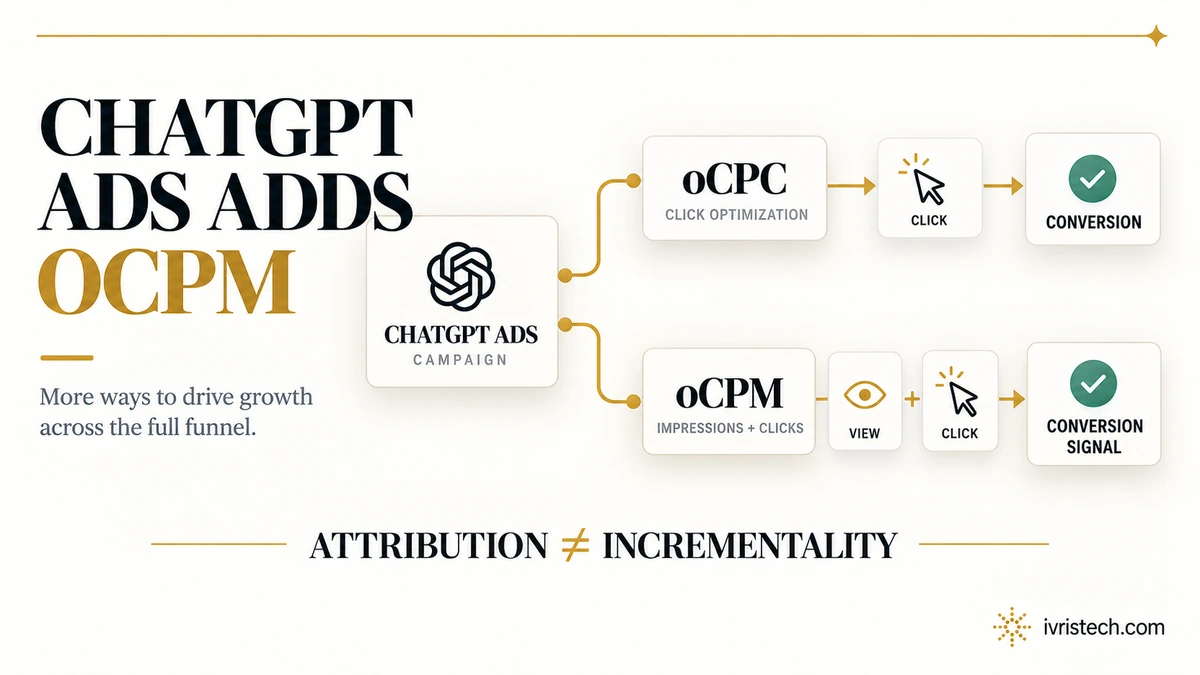
OpenAI has expanded its Conversion-optimized Campaigns documentation to include oCPM, an impression-billed option that still optimizes toward a selected conversion event. Unlike oCPC, which is billed on valid clicks and optimizes toward conversions after a click, OpenAI says oCPM can account for eligible conversion signals following both ad clicks and ad views. oCPM is beta, with access “rapidly expanding.”
The important change is not just billing. OpenAI separately says its existing one-day view-through metric, VTA (1d), remains supplemental reporting: it sits outside the main Conversions total and does not affect CPA, bidding, billing or conversion optimization. So oCPM should not be described as simply “bidding on VTA (1d).”
For B2B paid-media teams, that distinction matters. A buyer may see an ad during research, leave without clicking, return later through another route and submit a lead. oCPM gives ChatGPT Ads more eligible outcome signals to learn from, but a platform-attributed post-view conversion is not proof that the ad caused the conversion. Attribution, pipeline validation and incrementality remain separate questions.
Direct answer — what changed with ChatGPT Ads oCPM?
OpenAI now documents oCPM as a beta conversion-optimized campaign option billed on impressions. It can use eligible conversion signals after both ad views and clicks, while oCPC remains click-billed and post-click focused. OpenAI’s separate VTA (1d) reporting metric is still supplemental and does not itself affect optimization, so marketers should not treat oCPM and VTA (1d) as the same thing.
Key Takeaways
- oCPM is currently in beta, with OpenAI saying access is rapidly expanding.
- oCPC bills valid clicks and optimizes toward post-click conversions; oCPM bills impressions and can learn from eligible outcomes after views and clicks.
- Conversion tracking through the Conversions API and/or JavaScript Pixel is required, and conversion-optimized campaigns currently support one standard event, not custom events.
- OpenAI’s VTA (1d) remains separate supplemental reporting, so post-view attribution should not be read as causal lift.
What OpenAI Actually Changed
oCPM stands for optimized cost per mille. Advertisers choose the Conversions objective, select impression billing and pick one supported standard conversion event. OpenAI uses predicted conversion likelihood to compete in the auction while the advertiser is charged for impressions served, not for each conversion.
With oCPC, advertisers pay for valid clicks and the system optimizes toward conversions after a click. With oCPM, OpenAI says the optimization set can include eligible outcomes following both clicks and ad views. Its example is a person who sees an ad while exploring an idea, returns later and converts without clicking the ad directly.
The setup has hard boundaries. When we covered OpenAI’s Pixel and Conversions API rollout in May, that tracking layer was the prerequisite; it still is. Custom conversion events are not currently supported. The campaign objective, billing model and selected conversion event cannot be changed after creation; a different setup requires a new campaign, although OpenAI says an existing campaign can be cloned into oCPM.
There is also a rollout caveat. As of September 14, OpenAI’s dedicated conversion-optimization page now documents oCPM, but its broader campaign-creation page still lists only CPM, CPC and oCPC. Account-level availability should therefore take precedence over assuming every advertiser can select it.
Why View-Through Optimization Changes the B2B Measurement Question
Click-only optimization starts with an observable ad interaction. View-through optimization widens that path: the campaign can learn from some conversions that follow exposure even when no ad click sits immediately before the business action.
That can better fit assisted B2B journeys, but it makes cross-platform comparisons less clean. Google Ads lets advertisers configure view-through windows and uses view-through conversions for optimization in some campaign types. LinkedIn says most conversions default to a 90-day click and 90-day view window. ChatGPT Ads currently reports supplemental VTA on a fixed one-day window, while OpenAI says flexible click-through and view-through windows will be available “when available.”
A lower platform-reported cost per conversion is not automatically an apples-to-apples win. Attribution windows, event definitions and whether view-through outcomes enter optimization can all change the denominator.
The Attribution Catch: oCPM Does Not Prove Incrementality
OpenAI’s docs separate optimization signals from reported VTA (1d). The oCPM page says conversions after eligible views and clicks can inform delivery. The Measure Results page says VTA (1d) is supplemental, sits outside the main Conversions total and does not affect conversion optimization. OpenAI has not documented that those are the same signal or use the same window.
A post-view conversion means the platform found an eligible exposure before a later conversion under its attribution rules. It does not establish that the conversion would not have happened without the ad. That causal question belongs to incrementality testing and broader attribution design, not to a platform conversion column alone.
Our read: oCPM is an optimization expansion, not an incrementality product. For RevOps, keep three layers separate: platform-attributed conversions, CRM-qualified pipeline and incremental lift. oCPM can improve the first layer’s optimization inputs without proving the second or third.
What B2B Paid-Media Teams Should Do Now
First, verify that oCPM is actually available in your Ads Manager account. OpenAI still labels the feature beta.
Second, audit the event you want to optimize toward. OpenAI advises using an event with enough signal; very rare events are harder to evaluate. For B2B teams, that means not automatically choosing a sparse closed-won event when a qualified upstream event produces more reliable volume.
Third, if you test oCPM against the earlier click-billed ChatGPT Ads model, preserve the comparison. Keep creative, audience logic, geography and dates as consistent as possible, and report spend, impressions, clicks, click-attributed conversions, view-through reporting where available, CRM lead quality and pipeline separately.
Finally, normalize attribution windows before comparing ChatGPT Ads with Google, Meta or LinkedIn. The useful question is not “Which dashboard reports the lowest CPA?” It is “Which channel produces qualified pipeline under measurement rules we can explain and reproduce?”
Frequently Asked Questions
oCPC is billed on valid clicks and optimizes toward conversions after a click. oCPM is billed on impressions and optimizes toward a selected conversion event using a broader set of eligible signals, including outcomes after ad views and clicks. oCPM is currently beta, while access is expanding.
OpenAI has not documented that equivalence. Its oCPM page says eligible post-view and post-click conversion signals can inform delivery. Separately, the Measure Results page says VTA (1d) remains supplemental reporting and does not affect optimization. Marketers should avoid treating the VTA column as the documented oCPM bidding signal.
OpenAI requires conversion tracking through the Conversions API, the JavaScript Pixel, or both. The campaign needs at least one supported standard conversion event. Custom conversion events are not currently supported for conversion-optimized campaigns, and OpenAI recommends choosing an event with enough signal to evaluate performance.
No. OpenAI says the campaign objective, billing model and selected conversion event cannot be changed after campaign creation. To move from oCPC to oCPM, advertisers need a new campaign. OpenAI says an existing campaign can be cloned to create a new oCPM campaign where the beta is available.