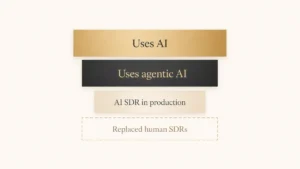
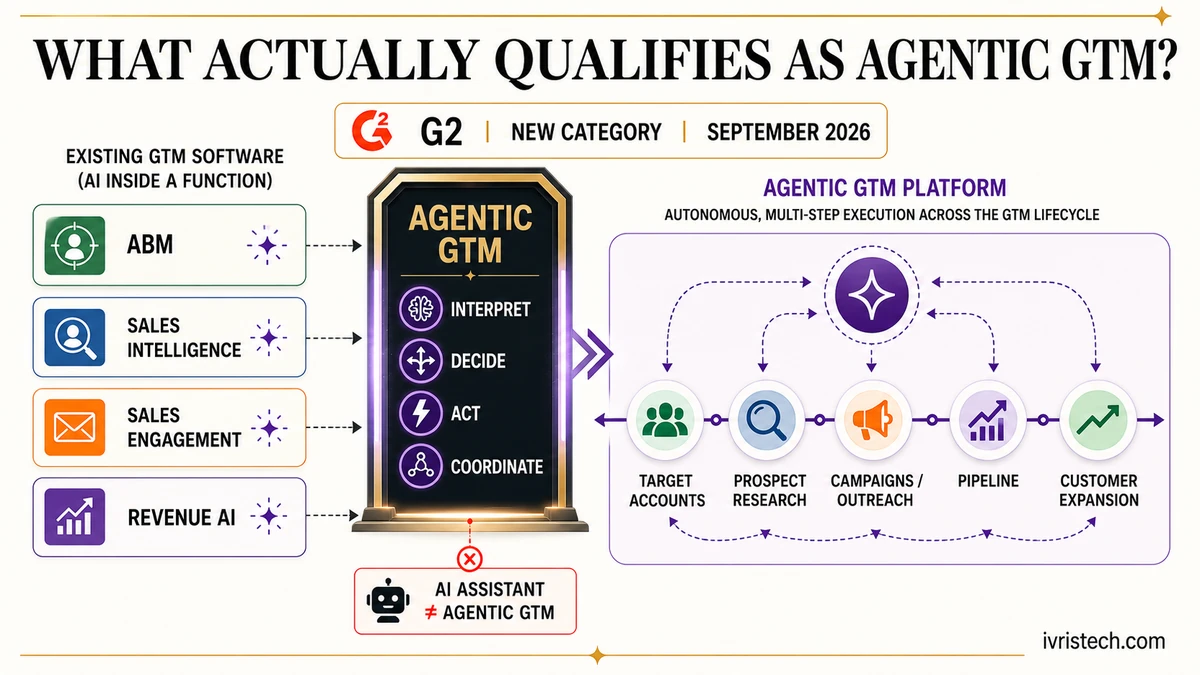
G2 created a new Agentic GTM Platforms category in an announcement published September 2, 2026, drawing a line between software that adds AI to an existing sales or marketing workflow and platforms built to let agents carry out go-to-market work across functional boundaries.
G2 treats Agentic GTM Platforms as an August 2026 addition on its research agenda. At launch, it named Demandbase One, 6sense Sales Intelligence, and Amplemarket as the three most popular products in the category.
For B2B buyers, the useful question is not whether a vendor has an “agent.” Older G2 categories already include AI, automation, and even built-in agents. The useful question is what the software can decide and execute, and whether that work crosses GTM functions.
Direct answer — What qualifies as an Agentic GTM Platform according to G2?
G2’s September 2 announcement defines the boundary around agents that interpret customer and market signals, make decisions, initiate actions, and coordinate multi-step workflows across the GTM lifecycle. An AI assistant or generative feature alone is not enough. As of September 3, IVRIS could not verify a separate public “To qualify for inclusion” checklist, so extra capabilities should not be promoted into formal G2 requirements.
Key Takeaways
- G2 publicly announced Agentic GTM Platforms on September 2, while its research agenda lists the category under August 2026.
- The launch boundary centers on four behaviors: interpret signals, make decisions, initiate actions, and coordinate multi-step workflows.
- Revenue AI is the closest existing G2 neighbor because it already requires built-in AI agents and human-in-the-loop capabilities.
- IVRIS’s September 3 desktop SERP check found Google already adding capabilities that G2 did not state as formal qualification requirements.
What G2 Actually Put Inside the Category
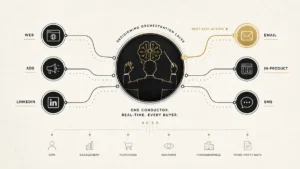
G2 describes Agentic GTM Platforms as software using AI agents to coordinate, execute, and optimize work from target-account identification and prospect research through engagement, pipeline management, and customer expansion. Its current category hierarchy places Agentic GTM Platforms under Artificial Intelligence → Agentic AI Software → AI Agents.
The stronger boundary appears in G2’s reason for creating the category. These systems are supposed to move beyond assistance and operate across prospecting, account research, ICP development, campaign execution, customer engagement, pipeline management, and revenue expansion. G2 separates software that layers AI onto an existing product from products designed around “autonomous, goal-oriented execution from the ground up.”
Where Agentic GTM Stops and Existing Categories Start
Account-based orchestration: G2’s ABM orchestration criteria require unified account data, lead-to-account matching, segmentation, coordinated multichannel engagement, and account-level measurement. They do not require autonomous agent decisions. An AI-driven ABM program can use agents heavily while remaining centered on the account-based motion.
Sales intelligence and sales engagement: Sales Intelligence centers on prospect information, search, triggers, contact data, and integrations. Sales Engagement can automate multichannel sequences, but G2 still defines it as a sales-facing product built around communication, standardized content, workflows, and analytics. Neither category requires autonomous, cross-functional GTM execution.
Revenue AI: This is the closest boundary. G2 already requires Revenue AI Platforms to provide all RO&I capabilities, include agents that perform tasks or recommend next steps, and allow human-in-the-loop controls. Agentic GTM therefore cannot be reduced to “agents act while Revenue AI analyzes.” The new category’s launch framing is broader, goal-oriented execution across GTM functions. Teams evaluating AI agents in RevOps should expect overlap between the definitions.
AI sales assistants: G2’s AI Sales Assistant bar is much narrower: automate basic sales tasks or provide predictive insights using embedded AI. That can exist without meeting the new category’s execution boundary.
One terminology note matters: G2 currently surfaces “Revenue Orchestration Platforms” as a theme under Revenue AI, not as a separate top-level software category. It is useful market language, but not a clean parallel G2 category.
The Hidden Catch: Search Is Already Expanding G2’s Definition
IVRIS checked the two desktop Google SERPs on September 3. The AI Overview for the branded query added API/MCP connectivity, approval gates, volume limits, and role-based access as “key capabilities.” The gap-check Overview went further, adding Agent-Qualified Leads, always-on availability, and headcount economics.
Those may be sensible evaluation questions. They are not the qualification language G2 published on September 2. Its announcement does not say a platform must support MCP, use AQLs, run 24/7, reduce headcount, or expose a particular approval model.
Our read: buyers should not turn common product features into hard category requirements before G2 does. Until G2 publishes a separate inclusion checklist for Agentic GTM Platforms, its launch definition should remain the controlling source.
What B2B Teams Should Ask Vendors Now
Ask a vendor to demonstrate one objective from signal to outcome. What changed in the data, what decision did the agent make, what action did it initiate, and which systems or teams did that action cross?
Then separate recommendation from authority. A tool that scores an account, drafts an email, or recommends a next step may be useful, but those behaviors already fit existing categories. The Agentic GTM claim becomes more meaningful when the system can adapt a multi-step workflow after context changes rather than waiting for a human to specify every next instruction.
Finally, map the product back to its older category home. If its core job is still ABM orchestration, sales intelligence, sales engagement, or RO&I, identify exactly what autonomous cross-functional execution has been added. The same discipline applies in GTM engineering: the category label does not remove the need to define data, orchestration, execution, and observability boundaries.
These are buyer tests, not invented G2 inclusion rules. The new category is useful precisely because it gives teams a harder question than “Where is the AI button?”
Frequently Asked Questions
No. G2’s ABM orchestration criteria center on unified account data, matching, segmentation, coordinated engagement, and account-level measurement. Agentic GTM is framed around autonomous, multi-step execution across GTM functions. A product can have strong ABM capabilities and still need broader execution to match the new framing.
Revenue AI is already agentic in G2’s taxonomy: qualifying products need RO&I features, built-in agents, and human-in-the-loop capabilities. Agentic GTM is framed more broadly around goal-oriented execution across the GTM lifecycle and functional boundaries. The definitions can overlap, so “execution versus analytics” is too simplistic.
Not according to G2’s September 2 announcement. The published boundary focuses on interpreting signals, making decisions, initiating actions, and coordinating multi-step GTM workflows. MCP may help agents connect to tools and data, but G2 did not list MCP support as a formal Agentic GTM qualification requirement.
G2 named Demandbase One, 6sense Sales Intelligence, and Amplemarket as the three most popular products in the category at launch. That list reflects popularity at the time of G2’s September 2 announcement; it is not a permanent ranking or the category’s complete product roster.