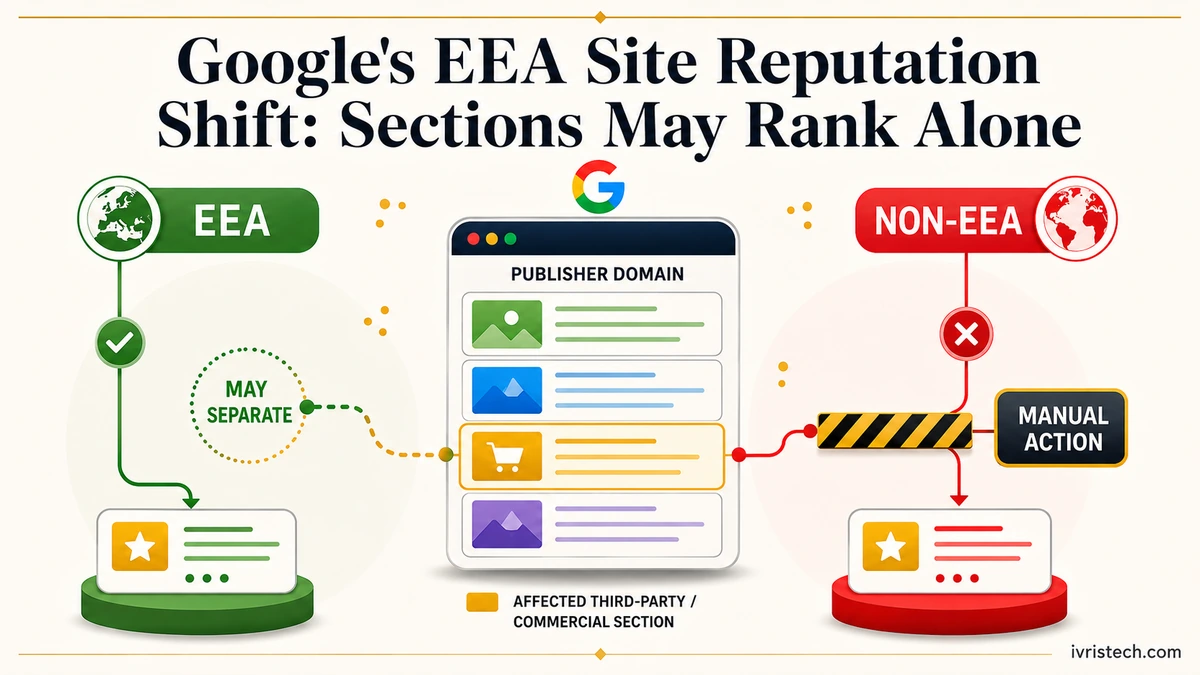
Google changed how its Site Reputation Policy manual actions affect search results in the European Economic Area on August 30, 2026. The change, announced by the Google Search Quality team on August 28, means a manual action still directly affects the relevant portion of a site for users outside the EEA, while its ranking impact does not apply to results shown to users inside the EEA.
The important catch is in Google’s updated Site Reputation Policy documentation. In EEA results, Google may categorize an affected section separately from the main domain so that it ranks more independently over time. Google says that categorization is not automatic, does not immediately remove the main site’s ranking signals, and is not itself a ranking signal.
For B2B publishers and SEO teams, this changes enforcement mechanics, not the underlying policy. Commercial, partner, affiliate, or third-party content is not automatically a violation, but a section built mainly to borrow a host domain’s established ranking signals can still face a different ranking model in the EEA and direct manual-action impact outside it.
Direct answer — does Google’s EEA change make site reputation abuse safe?
No. Beginning August 30, Site Reputation Policy manual actions no longer affect rankings shown to users inside the EEA, but the policy still applies. Google may separate an affected section from the main domain and let its systems learn to rank that section on its own merits. Outside the EEA, the manual action can still directly affect the relevant pages.
Key Takeaways
- Google announced the change on August 28, 2026, with the new treatment beginning August 30.
- Outside the EEA, a Site Reputation Policy manual action can still directly affect the relevant portion of a site.
- Inside the EEA, the manual-action impact does not apply, but Google may categorize the affected section separately and rank it more independently over time.
- Separate categorization is not automatic, does not instantly remove site-level ranking signals, and is not itself a ranking signal.
What Google Changed on August 30
The split is about the effect of a manual action, not whether Google can review a site. Site owners can still receive a Search Console notice, submit a reconsideration request, and, where eligible, use mediation. A page can carry a manual action while the ranking consequence is visible only outside the EEA.
That differs from the global framing around broader spam updates. In our earlier reporting on the March 2026 Google spam and core updates, the spam update applied across languages and locations. The Site Reputation Policy change instead makes the consequence of a specific manual action dependent on where the search user is located.
The change follows discussions with the European Commission. The Commission opened formal proceedings in November 2025 to assess how Google’s policy applies to publishers, including whether demotions involving commercial-partner content could restrict legitimate business and third-party cooperation. Opening the case did not prejudge a finding of non-compliance.
The Hidden Catch: A Section Can Still Rank More Independently
Removing the manual-action effect in EEA results does not guarantee that every affected page will benefit from the host domain exactly as before. Google says it generally presumes individual pages match the overall quality of other pages on the domain. When a section is categorized separately under this policy, that presumption no longer applies.
The section does not immediately lose all ranking signals from the main site. Google’s systems may learn over time to rank it independently as its own quality, relevance, integration, and other signals are evaluated. The categorization itself is not a negative ranking signal.
Our read: this is the part publishers should not reduce to “the penalty is gone in Europe.” The direct manual penalty is gone for EEA results, but a section that depended heavily on inherited domain reputation may still have less borrowed authority to lean on as Google learns to evaluate it separately.
What This Means for B2B Publishers
Sponsored articles, partner content, freelancers, affiliate pages, or third-party contributions are not inherently abusive. Google’s examples distinguish third-party content from content published mainly to manipulate rankings. Editorial work and integrated commercial content meant for readers can fall outside the abuse definition.
For B2B publishers, the practical test is editorial integration rather than the label on the commercial relationship. Google’s human-review guidance points to four factors: whether presentation matches the host publication, whether quality is consistent, whether authorship and editorial responsibility are clear, and whether the same or near-identical material appears across other sites.
A white-label section that exists largely because a strong domain can rank it is still exposed. A partner section with clear ownership, editorial control, original value, and a genuine reader purpose has a stronger policy position. Neither outcome is determined simply by being in the EEA.
What SEO Teams Should Do Now
- Split reporting by market. Compare EEA and non-EEA countries because the same page can now face different manual-action effects based on the searcher’s location.
- Treat every Search Console notice as operationally relevant. Stable EEA rankings do not mean the issue disappeared. The same action can still affect non-EEA demand, while the section may be evaluated more independently inside the EEA.
- Audit third-party sections against Google’s four review factors. Check presentation, quality consistency, authorship and responsibility, and duplication across sites. A “sponsored” or “editorial” label is not a substitute for integration.
- Ask whether the section can earn rankings without borrowed reputation. A durable B2B SEO strategy built around first-party authority and reader value is safer than a commercial section whose search case depends on the host domain carrying it.
Google has made enforcement geographically asymmetric. It has not made reputation borrowing a safe SEO model for the EEA.
Frequently Asked Questions
Yes, the policy still applies and Google can still review affected sections and notify site owners in Search Console. What changed on August 30 is the ranking impact of the manual action: it does not apply to results shown to EEA users, while affected sections may instead be categorized separately.
Potentially over time, but not automatically or immediately. Google says separate categorization removes its general presumption that the section matches the domain’s overall quality. The section does not instantly lose the main site’s ranking signals; Google’s systems may learn to rank it more independently on its own merits.
Yes. The manual action can still directly affect relevant pages for users outside the EEA, so international B2B demand may be exposed even if EEA visibility looks stable. The notice also signals that Google found the section out of line with the policy, which remains relevant to reconsideration and editorial review.
No. Google says third-party content alone is not inconsistent with the policy. The key question is whether it is published mainly to exploit the host site’s established ranking signals. Google’s updated guidance also considers editorial integration, quality, authorship and responsibility, and whether content is duplicated across other sites.