OpenAI published Work at the Frontier on July 27, 2026, finding that 53% of marketers’ occupation-specific ChatGPT messages involved tasks associated with another occupation. The analysis covered more than 800,000 work-related messages from U.S. users and put marketing among five groups where most non-generic AI use crossed a traditional role boundary.
The 53% number is not a share of marketers’ time or all their AI use. Across every work-related marketer message, including generic tasks, the cross-occupation share was 24.3%. Marketing tasks also represented 8.9% of messages from workers in other fields, the highest outward share among the eight groups studied.
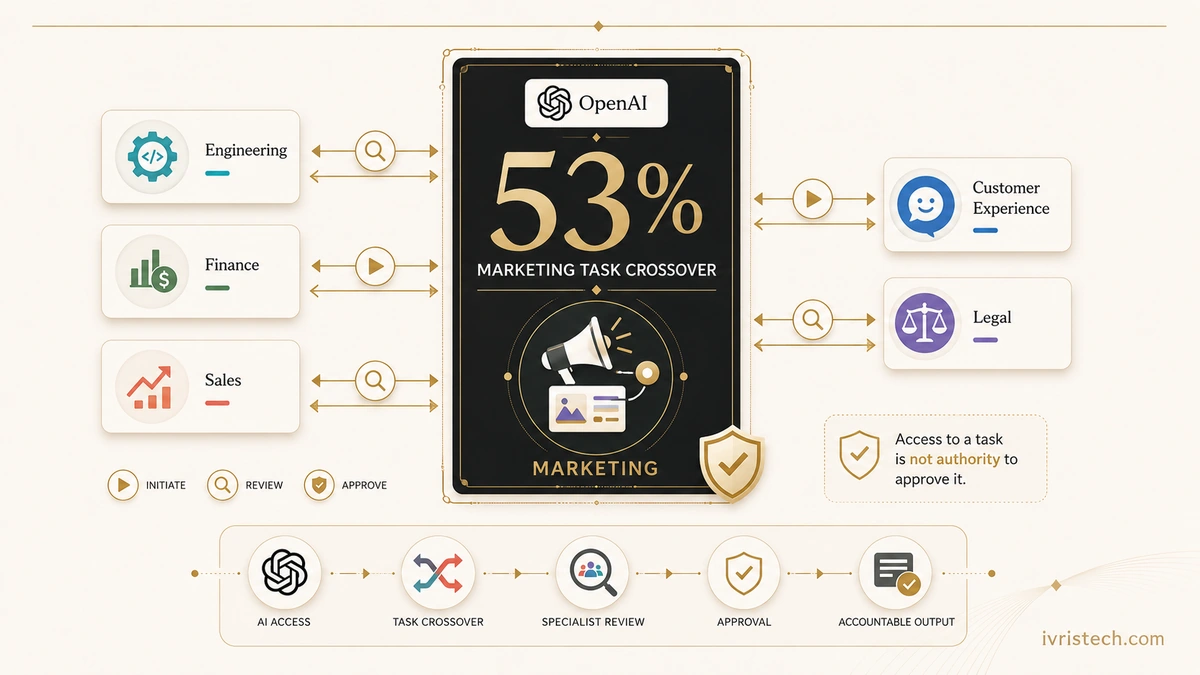
Our read: marketing is becoming a two-way AI service layer. Marketers are initiating work that once required engineering, finance, sales, or customer-experience specialists, while colleagues elsewhere are producing marketing materials and plans. That expands who can start the work. It does not transfer review authority, approval rights, or accountability.
Direct answer – What did OpenAI find about marketers crossing job boundaries with AI?
OpenAI found that 53% of marketers’ occupation-specific ChatGPT messages were mapped to tasks associated with another occupation. That denominator excludes generic work. Across all marketer work messages, the comparable share was 24.3%. Marketing tasks also accounted for 8.9% of messages from workers in other fields, showing that marketing both borrows specialized work and supplies work across the organization.
Key Takeaways
- OpenAI analyzed more than 800,000 work-related messages and published the findings on July 27, 2026.
- Across the full sample, 16.8% of work-related messages crossed occupations; among non-generic, occupation-specific messages, the share was 43.5%.
- For marketers, 53% of occupation-specific messages crossed job boundaries, while the all-message share was 24.3%.
- Marketing tasks accounted for 8.9% of messages from workers in other fields, the highest outward share in the sample.
- The report measures messages, not work hours, output quality, productivity, hiring effects, or specialist review.
What OpenAI Actually Measured
The OpenAI Economic Research report used role information supplied through ChatGPT Business to place users in eight occupation groups: customer experience, design, engineering, finance, human resources, legal, marketing, and sales. The analyzed messages came from those users’ individual ChatGPT accounts. OpenAI mapped each message’s main activity to the U.S. Department of Labor’s O*NET task framework.
OpenAI classified 61.5% of work-related messages as generic because activities such as writing, summarizing, and scheduling appear across many jobs. Another 21.8% mapped within the user’s occupation, and 16.8% mapped to another occupation. Once generic work was removed, cross-occupation messages represented 43.5% of the remaining occupation-specific set.
This is a different question from our earlier reporting on OpenAI’s B2B Signals benchmark, which examined how deeply organizations use AI. Work at the Frontier examines whose traditional task is being attempted. OpenAI also cautions that the sample is not representative of the U.S. workforce and should not be generalized to ChatGPT Enterprise users.
Why Marketing Sits on Both Sides of Task Crossover
Marketing stands out because it moves in both directions. Marketers used AI for work associated with other fields, and workers in other fields used AI for marketing work. Among non-marketers’ marketing-related messages, developing promotional materials was the largest task category at 25%. The examples included ads, social posts, flyers, promotional videos, presentations, product sheets, and campaign graphics.
That two-way movement matters more than a profession ranking. Marketing is becoming an accessible layer of work across the company, while marketers gain first-pass access to technical, financial, customer, and operational tasks. The finding is adjacent to our reporting on quiet B2B marketing role reductions, but the datasets differ: Wynter measured staffing decisions; OpenAI measured message content.
The pattern was modestly stronger for typical-volume users in smaller workspaces: 18.9% of messages crossed occupations in workspaces with two to five seats, versus 16.3% in those with 101 or more. Seats are not company size, but the result fits a familiar constraint: lean teams reach for AI when a specialist is unavailable.
The Hidden Catch: Starting Specialist Work Is Not Owning It
Task crossover can remove a handoff at the beginning of a workflow. OpenAI gives the example of a marketer troubleshooting a website or writing a simple script before asking a developer for help. Across the wider sample, financial calculations and software troubleshooting appeared repeatedly outside their traditional fields. The report does not show that the output meets specialist standards or that the person initiating it should make the final decision.
The practical response is to map the process before expanding automation and separate three rights that often get blurred:
- Initiate: who may use AI to research, diagnose, or draft a first pass.
- Review: which specialist checks assumptions, accuracy, risk, and context.
- Approve: who remains accountable when the output affects customers, money, systems, contracts, or public claims.
Our stance is simple: broader task access is useful; silent authority transfer is not. A marketer producing a first-pass SQL query or financial model may shorten the queue. It does not make marketing accountable for database integrity or financial sign-off.
What B2B Teams Should Change Now
- Log crossover for 30 days. Record recurring tasks started outside the home function, the tool, the reviewer, and whether rework was needed.
- Set review rules by risk. Brand copy may need marketing approval; pricing models need finance; code changes need engineering; contract language needs legal review.
- Measure quality, not prompt volume. Track corrections, review time, rejected outputs, cycle time, and incidents before changing staffing assumptions.
- Keep a learning path. Let junior employees build judgment through supervised work instead of turning them into permanent reviewers of machine output.
The copilot-to-autopilot progression in our agentic AI marketing workflow guide applies here: broaden task initiation first, then delegate bounded steps only after review data supports the change. OpenAI’s findings are evidence that job boundaries are already becoming more permeable. They are not evidence that specialist accountability has become optional.
Frequently Asked Questions
Task crossover is OpenAI’s term for a work-related AI message whose main activity is historically associated with an occupation other than the user’s own. OpenAI mapped messages to O*NET activities, removed broadly shared generic tasks, and compared the remaining activity with the user’s self-reported occupation group.
The 53% figure uses only occupation-specific messages after generic work is excluded and the remainder is rebased to 100%. The 24.3% figure uses all work-related messages from marketers, including generic activities. Both are valid, but they answer different questions and should not be presented as shares of working time.
No. The report shows what kinds of tasks appeared in messages, not whether outputs were used, accurate, productive, or reviewed. OpenAI explicitly says the findings are not estimates of employment gains or losses. Specialists may remain essential for expert judgment, risk control, and final approval.
Track which cross-functional tasks marketers already attempt, assign a qualified reviewer to each risk category, and separate permission to start work from authority to approve it. Measure correction rates, review time, and incidents before redesigning roles. The immediate job is governance, not flattening specialist teams.