Nielsen launched Ad Intel AI on July 27, 2026, turning its competitive advertising database into a conversational decision engine and making the intelligence available to customer-built agents through Model Context Protocol.
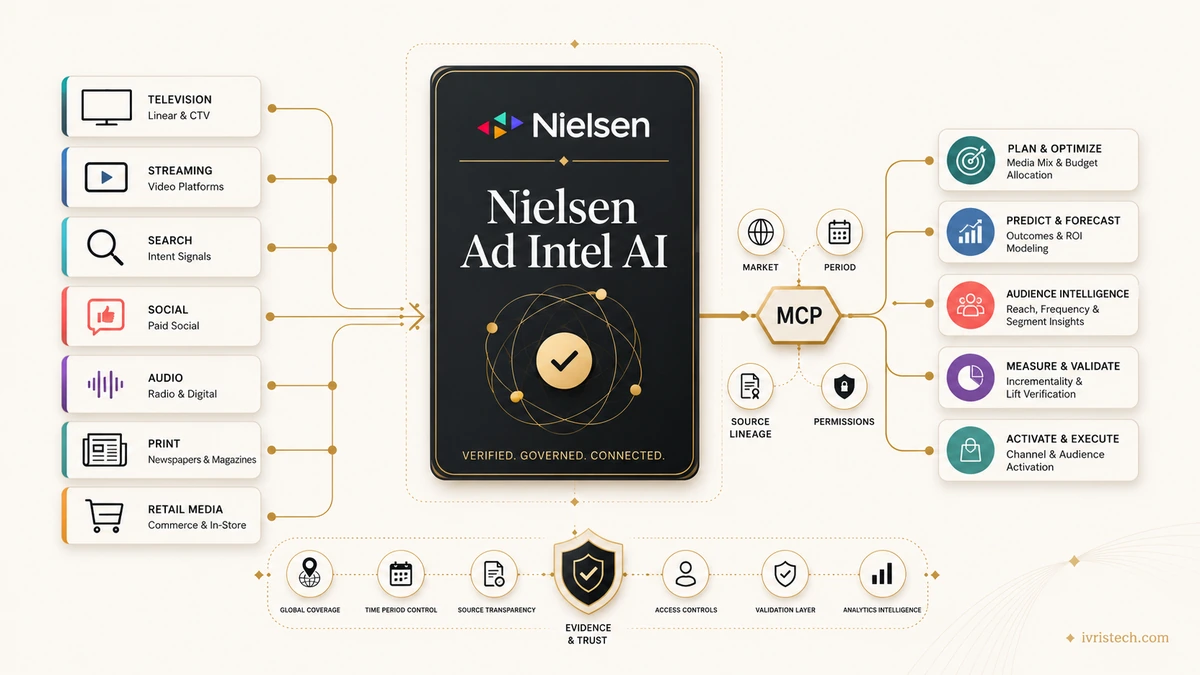
The scale is substantial. Nielsen says Ad Intel monitors 5.5 million brands and 4.6 million advertisers across 23 media types in more than 90 international markets. Its AI layer structures video, images, audio, and text, then checks answers against panel-based behavioral data, Nielsen schemas, business definitions, and expert-reviewed benchmarks.
For B2B media teams, the important change is not the chat interface. It is the ability to bring competitor spend, creative, and market intelligence into an agent workflow. That can shorten analysis, but it also makes evidence quality, permission scope, and recommendation lineage part of the buying decision.
Direct answer – what did Nielsen launch with Ad Intel AI?
Nielsen Ad Intel AI adds conversational analysis and recommended actions to Nielsen’s cross-media advertising intelligence. It can also be exposed through MCP so customer-built agents and platforms can query the data inside their own workflows. The buyer caveat is that Nielsen’s launch announcement does not detail pricing, access scopes, query logs, or how recommendation evidence will be displayed.
Key Takeaways
- Nielsen launched Ad Intel AI on July 27, 2026.
- Ad Intel covers 5.5 million brands, 4.6 million advertisers, 23 media types, and more than 90 international markets.
- The product moves Ad Intel from reporting toward conversational analysis and recommended action.
- MCP access lets customer-built agents and platforms query Nielsen intelligence inside client workflows.
- Buyers still need clear answers on permissions, lineage, logging, pricing, and recommendation validation.
What Nielsen Ad Intel AI Actually Changes
Nielsen’s existing Ad Intel product tracks where competitors spend, which creative they run, and how activity changes across television, streaming, retail media, search, social, audio, print, and other channels. Ad Intel AI adds a natural-language layer intended to surface creative patterns, detect emerging trends, identify competitor spend shifts, and recommend what a user should examine next.
That moves the workflow from retrieving a report to asking a business question. An analyst could compare channel shifts, investigate launch-window messaging, or examine where category activity is rising. These are plausible uses, not confirmed templates or guaranteed outputs.
The pattern is similar to AI-assisted podcast media discovery: ranking and summarization can reduce research time, but the output remains a starting point for judgment. A fast answer is useful only when the analyst can inspect the market, period, media type, and assumptions behind it.
MCP Is the More Important Product Shift
The Model Context Protocol specification gives AI applications a standard way to connect with external data and tools. Nielsen says Ad Intel AI can be exposed through MCP so customer-built agents and platforms can query its intelligence directly.
That makes Ad Intel AI relevant beyond Nielsen’s own interface. A planning agent could potentially call Nielsen data while assembling a market brief, comparing creative themes, or reviewing a proposed media allocation. It is the same broader shift covered in our guide to AI agents in marketing: the value moves from generating text to completing a multi-step workflow with approved data.
Our read: MCP is the real product change. Conversational search makes Ad Intel easier to use, while agent access makes it part of another system’s decision path. That also brings the permission test we identified in Cordial’s headless marketing infrastructure: which identity can query the service, which markets and datasets it can reach, and how each request is reconstructed later.
The Missing Buyer Details Are About Evidence
Nielsen describes a two-layer grounding architecture. Raw media inputs are converted into structured datasets, then combined with panel-based behavioral data and evaluated against Nielsen schemas, business definitions, and expert-reviewed benchmarks. Nielsen Chief Product Officer Akhil Parekh framed the advantage as the data and orchestration around the model; the company says accuracy barely moves if the foundation model changes.
That is stronger than putting a generic model on a dashboard, but buyers still need answer-level evidence. Each response should show its date range, geography, channel coverage, taxonomy, source freshness, and methodology. Without that context, a precise answer can still be applied to the wrong market or period.
Competitive intelligence also does not prove that a media choice created pipeline. A rival’s spend shift can inform a hypothesis, while B2B attribution software and controlled tests address whether the buyer’s own campaign produced revenue. Teams should keep those jobs separate rather than treating competitor activity as performance evidence.
The July 27 announcement does not specify public pricing, MCP access tiers, query or rate limits, role-based scopes, audit-log fields, or customer benchmarks. Those are not reasons to dismiss the launch. They are the questions a procurement or pilot process now needs to answer.
What B2B Media Teams Should Test First
- Start with known questions. Run a small set of competitor-spend and creative queries that an analyst has already answered manually, then compare accuracy and time saved.
- Inspect answer lineage. Require every recommendation to expose its geography, period, media types, taxonomy, source freshness, and supporting evidence.
- Scope MCP access narrowly. Separate who can query data from who can approve a budget change or activate a campaign in another system.
- Test ambiguous prompts. Use brand aliases, regional names, and overlapping product categories to see how the system resolves identity and definitions.
- Measure decisions, not chat speed. Track whether the workflow improves research quality, planning time, test design, and downstream campaign outcomes.
Nielsen has a credible data advantage and a clear route into agent workflows. The launch becomes materially more valuable when buyers can verify what each answer used, limit what each agent can access, and keep recommendation authority separate from media activation.
Frequently Asked Questions
Nielsen Ad Intel AI is a conversational layer for Nielsen’s competitive advertising intelligence. It is designed to analyze spend, creative strategy, market activity, and emerging trends across Ad Intel datasets, then return faster answers and recommended actions instead of requiring users to work only through static reports.
Nielsen says Ad Intel monitors 5.5 million brands and 4.6 million advertisers across 23 media types in more than 90 international markets. Coverage includes major television, streaming, retail media, search, social, audio, digital, and print environments, although exact availability can vary by market.
Nielsen says Ad Intel AI can be exposed through Model Context Protocol so customer-built agents and platforms can query its intelligence directly. That can place competitor and creative analysis inside an existing planning workflow. Buyers should still confirm authentication, scopes, logging, rate limits, and available datasets.
Nielsen did not publish Ad Intel AI pricing in its July 27 launch announcement. Prospective buyers should ask whether conversational and MCP access are included in existing Ad Intel contracts, which markets and media types are licensed, and whether usage, custom integrations, or agent access carry separate fees.