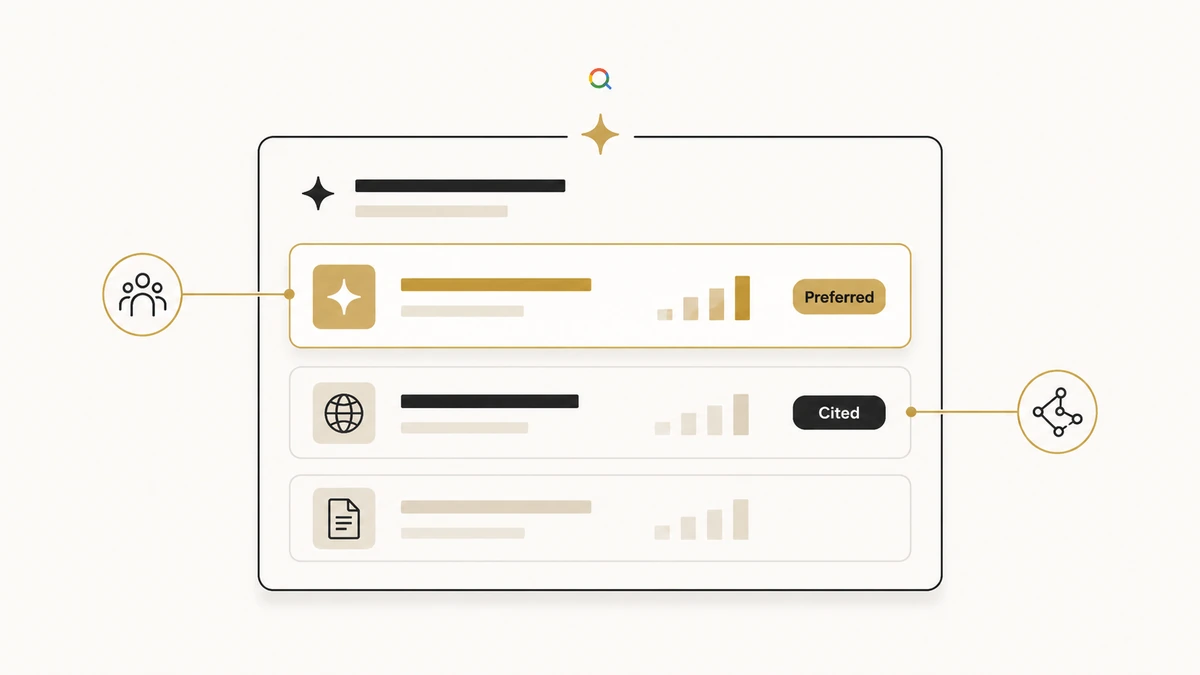
Google extended its Preferred Sources feature into AI Overviews and AI Mode on May 27, the first time the personalization control has reached inside AI-generated answers instead of living only in the Top Stories carousel. In a post by Search product manager Duncan Osborn, Google said links from sites a reader has selected will now appear with a visible “Preferred” label inside AI responses, and it introduced a separate “Highly Cited” badge for articles other publishers reference most.
Google attached one number to the change: readers are twice as likely to click through to a Preferred Source, and more than 345,000 sites have already been designated as one. Two carousels ship alongside the labels. One surfaces Preferred Sources on developing-topic queries; a second, arriving soon, pulls firsthand perspectives from forums and social posts.
For B2B teams, this is the first Google-owned lever on AI-answer visibility since the channel pulled away from organic search. When we covered the collapse in overlap between Google’s top 10 and AI-cited sources earlier this month, the conclusion was blunt: ranking and citation had decoupled, and B2B brands had no Google-side control over what an AI answer named or linked. Preferred Sources and the Highly Cited badge hand some of that control back, on Google’s terms. Earn reader selection, earn citations from other publishers, and you appear labeled inside the answer rather than buried in a source tray nobody opens.
Key Takeaways
- Google brought Preferred Sources into AI Overviews and AI Mode on May 27, 2026, and added a new “Highly Cited” badge for articles other publishers reference most, per a blog post by Search PM Duncan Osborn.
- Preferred Sources now appear with a visible label inside AI answers, not just the Top Stories carousel. Google says readers are 2x more likely to click a Preferred Source, and 345,000+ have already been selected.
- Two carousels accompany the labels: a developing-topic carousel highlighting Preferred Sources, and a forthcoming forum-and-social perspectives carousel.
- Both signals are earned, not bought. Preferred status comes from readers adding you in Search settings; the Highly Cited badge comes from other publishers citing your reporting.
- For B2B, this rewards two things most vendor blogs underinvest in: an owned audience that will select you, and original primary-data reporting other sites cite.
What Google Shipped on May 27
Preferred Sources is not new. Google launched it in August 2025 as a way to tell Search which publishers you want to see more of in the Top Stories carousel. What changed on May 27 is reach: the selections now carry into AI Overviews and AI Mode, the surfaces that absorbed the bulk of publisher click loss over the past year. A control that used to shape one carousel now shapes the AI answer itself.
The “Highly Cited” badge is the more interesting half. It flags articles that other news stories and publishers cite most, marking original reporting and influential coverage directly on the results page. Google frames it as a reader aid for spotting primary sources. Read as a ranking signal, it is Google telling publishers what it values: be the source other people cite, not the page that restates what they said.
Setup sits in Search personalization settings under source preferences, and Google says any site that publishes fresh content is eligible. There is no application, no fee, and no verification gate. The developing-topic carousel is live now; the forums-and-social carousel is the one to watch, because it formalizes the same Reddit-and-community pull that already dominates AI citation share.
Why It Matters for B2B Marketers
Our read: the headline is not the feature, it is who it rewards. Preferred Sources is personalized, so it compounds for brands that already have an audience and does nothing for brands that don’t. A reader has to know you well enough to add you. That makes this a loyalty-to-visibility multiplier, not a discovery channel, and it is the rare AI-surface mechanic a B2B brand can influence directly rather than wait on. Measuring that compounding effect is now possible too: the first Share-of-Voice metric Google built for AI answers sits inside Merchant Center, quantifying visibility across AI Mode, AI Overviews, and Gemini.
The Highly Cited badge lands on the same fault line we flagged in our coverage of ghost citations, where 61.7% of AI citations name a domain in the source list but never in the answer text. A badge that rewards being cited by other publishers is Google nudging the open web back toward original reporting as the thing that earns recognition. For B2B, that points where the data has pointed for months: proprietary benchmarks, named surveys, and first-party numbers get cited; restated industry stats get ghosted.
It also reframes the surface-portfolio problem. When we wrote about the May 2026 core update, the argument was that a B2B content program now has to be eligible across five surfaces at once. Preferred Sources adds a sixth lever, and it is the only one keyed to your existing audience rather than to anonymous reach. With AI chatbots now building 54% of B2B software shortlists, a labeled, preferred slot inside the answer sits closer to the buying decision than a blue link ten results down.
The Catch Most Coverage Skips
Three limits keep this from being a free win. First, personalization caps the ceiling. A Preferred Source label only shows to people who already added you, so the feature cannot manufacture new reach; it can only protect and deepen the audience you have. Cold prospects in your category will not see the label until they choose you, which is the opposite of how most B2B demand programs are sequenced.
Second, the Highly Cited badge favors publishers and original-reporting outlets over vendor blogs. Most B2B content restates third-party research instead of producing it, which is exactly the profile the badge passes over. Earning it means committing budget to primary data, and that is a multi-quarter investment, not a settings toggle.
Third, this is a Google answer to a problem Google’s own AI surfaces created. The 2x click-through figure is Google’s, measured on Google’s surface, and it describes engagement among readers already inclined to click. It is a real signal for retention, not proof that Preferred Sources reverses the broader traffic compression AI answers introduced.
What B2B Teams Should Do in the Next 30 Days
Four moves, in priority order.
Run a “make us a preferred source” push to your owned audience. The highest-payoff action is the simplest: tell your newsletter list, LinkedIn followers, and customers how to add you under source preferences in Google Search settings. This is the only AI-visibility lever that responds to a direct ask. A brand with 20,000 engaged subscribers can move its labeled-answer presence in a week, where a citation strategy takes quarters.
Shift content budget toward original, citable reporting. The Highly Cited badge and the AI-citation data point the same way. Allocate a fixed share of the content calendar to proprietary research: customer benchmarks, survey data, internal-tooling results, each with named methodology. These are the assets other publishers cite, and citation is now a visible badge, not just an abstract authority signal.
Build third-party citation density deliberately. Pitch your primary data to trade publications, analysts, and journalists. Each external citation feeds the Highly Cited input and the same domain-authority signals AI engines reward. Treat digital PR as an AI-visibility channel, not a brand-awareness afterthought.
Track the new surfaces separately. Add a segment for AI-referral and Preferred-Source-driven traffic, and watch whether the developing-topic carousel sends measurable sessions to your news-style pages. The teams that measured AI surfaces separately through the core-update window are the ones who will know whether Preferred Sources moves anything for B2B, rather than guessing from a blended number.
Frequently Asked Questions
Google extended Preferred Sources into AI Overviews and AI Mode, so links from sites a reader has selected now appear with a visible “Preferred” label inside AI answers, not only in the Top Stories carousel. Google also added a “Highly Cited” badge for articles other publishers reference most, plus a carousel that surfaces Preferred Sources on developing-topic queries.
There is no application or fee. Readers add a site under source preferences in Google Search personalization settings, and Google says any site publishing fresh content is eligible. Because it is reader-selected, the practical path for a B2B brand is asking its existing audience to add it, rather than optimizing a single page.
The Highly Cited badge marks articles that other news stories and publishers cite most, flagging original reporting on the results page. It is earned by publishing primary data and analysis other sites reference, such as proprietary benchmarks, surveys, and first-party numbers, not by restating existing research.
Only indirectly. Preferred Sources is personalized, so the label shows to readers who already selected you; it deepens visibility with an existing audience rather than creating cold reach. Its value is protecting and compounding the audience you have, on a surface that sits close to the buying decision.