The Interactive Advertising Bureau released “Measuring Visibility in the AI Era” on August 3, 2026, giving brands, publishers, agencies, and measurement providers a shared vocabulary for organic visibility in AI-powered discovery. The IAB AI visibility measurement framework covers metric definitions, data-quality tiers, provider disclosures, and measurement stability.
IAB says more than 20 companies now sell AI visibility tools, often using methods that produce different answers for the same brand. That makes a visibility score hard to compare unless the buyer can see the prompt library, platforms, collection method, weighting, validation, and treatment of model changes behind it.
Our read: the important release is not another score. It is a common language for challenging the score. B2B marketers should use the guidance as a procurement and reporting discipline, not as regulation, provider certification, or evidence that higher AI visibility directly caused revenue.
Direct answer: What does the IAB AI visibility measurement framework change?
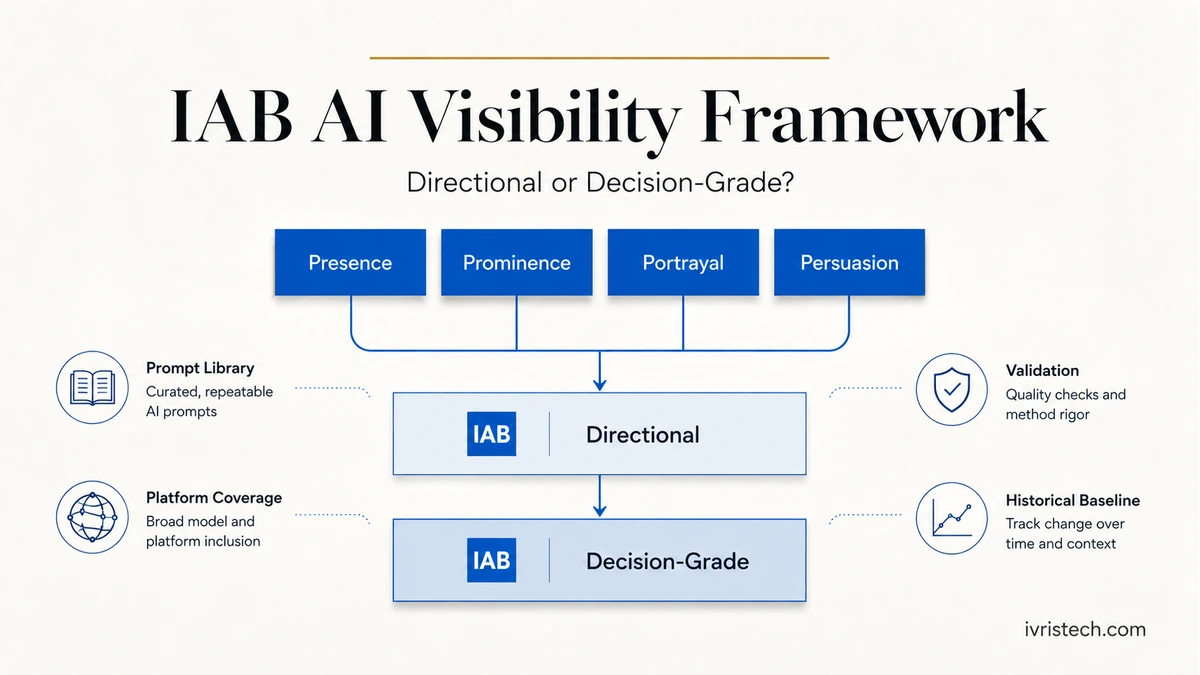
IAB gives the market common definitions for presence, prominence, portrayal, and persuasion, then separates directional signals from decision-grade measurement. For B2B buyers, the practical change is a disclosure test: providers should explain what they measure, how they collect it, how stable it is, and which decisions the data can support.
Key Takeaways
- IAB published its AI visibility measurement guidelines on August 3, 2026.
- The four Ps are presence, prominence, portrayal, and persuasion.
- Fewer than 50 queries per measurement program are treated as exploratory rather than directional.
- Decision-grade data requires stronger prompt coverage, cadence, reproducibility, validation, documentation, and platform coverage.
- The guidance covers organic visibility and does not certify providers or prove revenue causation.
What IAB Actually Released
The framework organizes brand and publisher metrics into four layers. Presence covers whether a brand is mentioned or a publisher is cited. Prominence asks where and how substantively it appears. Portrayal covers sentiment, framing, hallucinations, and factual inaccuracies. Persuasion includes recommendation strength and post-citation click-through rate.
That hierarchy matters because a citation, a named mention, a favorable description, and a click are not interchangeable outcomes. Our earlier analysis of ghost citations in AI search showed why a domain can be cited without the brand being named. A single blended “visibility” score can hide that difference.
The release is standardized industry guidance, not binding regulation. Caroline Giegerich, IAB’s vice president of AI, told AdExchanger that it is not a formal standard because AI-search measurement is not stable enough. The document also says it does not establish provider certification or evaluate individual vendors.
Why AI Visibility Needs a Common Measurement Language
AI outputs are non-deterministic. The same query can surface different brands, sources, and framing across repeated runs. Providers can also choose different prompts, intent mixes, geographies, models, retrieval settings, and weighting rules. Two dashboards can therefore disagree without either exposing why.
A common language does not eliminate variation. It makes the variation inspectable. IAB requires component metrics to remain accessible beneath any composite index, per-platform results to be reported separately, and model or platform changes to be disclosed when they reset the baseline.
This also clarifies ownership. The B2B GEO ownership gap is partly a measurement-governance problem: one accountable operator needs to approve the prompt set, definitions, source-of-truth data, and decision threshold before a score reaches leadership.
Directional vs. Decision-Grade: The Line B2B Teams Should Enforce
Directional data is useful for trend monitoring, early signal detection, competitive awareness, and internal briefings. IAB’s criteria matrix says it is not sufficient for budget allocation, provider selection, or executive strategy. Programs with fewer than 50 queries are classed as exploratory, below even the directional tier.
Decision-grade measurement demands more: enough repeated responses to establish a stable distribution, a large and diverse query set, coverage of informational, comparison, recommendation, and transactional intents, weekly or more frequent testing for active budget decisions, disclosed variation ranges, documented validation, and per-platform reporting.
The distinction also prevents unlike signals from being collapsed. Log-level AI-agent activity, simulated answer monitoring, passive user panels, and platform-native data can all be useful, but they are different collection architectures. A provider should not present them as equivalent without disclosure.
What B2B Marketers Should Demand From Measurement Providers
Our comparison of AI SEO tools and GEO platforms can help create a shortlist. IAB’s guidance supplies the harder part of the buying process: testing whether the data behind the demo is fit for the decision.
- A declared use case and quality tier: Ask whether the output is exploratory, directional, or decision-grade, and which decisions it is designed to support.
- Prompt-library transparency: Require query volume, intent distribution, category coverage, weighting, refresh cadence, and whether prompts come from synthetic lists, search demand, observed behavior, or a mix.
- Platform and model specificity: Require per-platform results, model versions, retrieval settings, and the weighting used in any combined score.
- Collection-method disclosure: Ask whether the provider uses active simulations, passive panels, platform-native data, browser observation, APIs, scraping, or a hybrid.
- Reproducibility and validation: Require typical variation ranges, confidence levels, repeat-run procedures, outlier handling, entity disambiguation, and the external signals used for validation.
- Historical versioning: Ask how model updates, platform changes, and re-baselining events are recorded so pre-change and post-change trends are not presented as one continuous series.
One final boundary matters. IAB’s current work measures organic visibility. Post-citation click-through rate is a bridge metric, while full attribution is reserved for a forthcoming framework. Decision-grade visibility data can support a better marketing decision; it does not, by itself, prove that visibility caused pipeline or revenue.
Frequently Asked Questions
It is IAB’s August 2026 guidance for measuring organic brand and publisher visibility in AI-powered discovery. It defines the four Ps of visibility, distinguishes directional from decision-grade data, sets provider-disclosure expectations, and explains how measurement programs should handle non-deterministic outputs and platform changes.
Directional data identifies broad patterns and trends. It can support early signal detection, competitive awareness, and internal briefings, but IAB says it lacks the rigor needed for budget allocation, provider selection, or executive strategy. A program with fewer than 50 queries is considered exploratory rather than directional.
Decision-grade measurement uses a large, diverse query set, repeated responses, all four prompt-intent types, frequent testing, disclosed variation ranges, documented validation, methodology detail, and broad platform coverage. Providers should also report per-platform results and explain how any combined score is weighted.
No. Visibility measurement describes whether and how a brand or publisher appears in AI responses. IAB includes post-citation click-through rate as a bridge metric, but full attribution is outside this framework. Revenue claims still require separate evidence connecting exposure to qualified behavior, pipeline, or sales.