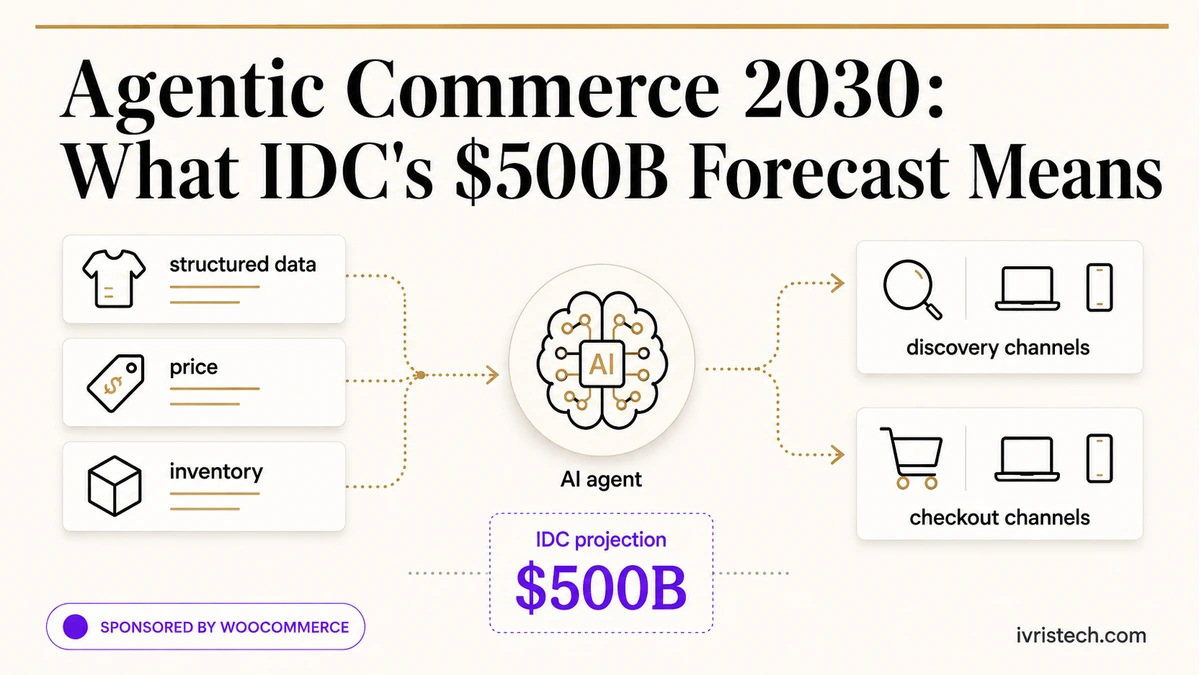
WooCommerce published an IDC InfoBrief it sponsored on July 27, 2026, with a headline forecast: IDC projects that AI agents could replatform $500 billion in digital spending by 2030. The InfoBrief is titled Build for What’s Next: Open-Source Architecture and the Future of AI Commerce.
IDC also projects a 10-fold increase in AI-agent use among Global 2000 companies by 2027 and says 45% of organizations could orchestrate AI agents at scale by 2030. These are forecasts, not evidence of today’s consumer purchasing behavior. WooCommerce summarizes the findings publicly, but gates the full study, leaving detailed modeling assumptions outside the public copy.
Our read: the important part is not a prediction that AI will create $500 billion in new demand. It is that existing digital spending may move through new discovery, comparison, and transaction layers. Product information, pricing accuracy, inventory freshness, and system interoperability could matter more without making an immediate platform rebuild necessary. Meta’s Muse virtual-card checkout model makes that readiness question more immediate because a merchant can potentially receive an agent-originated order before it has adopted a dedicated agent-commerce protocol.
Direct answer: What does IDC’s agentic commerce 2030 forecast mean?
IDC projects that AI agents could redirect $500 billion in digital spending by 2030. The forecast concerns spending replatformed through agent-enabled discovery and commerce systems, not necessarily $500 billion in additional consumer demand. For merchants, the practical implication is to improve machine-readable product data and integration readiness while treating adoption as uncertain.
Key Takeaways
- The IDC InfoBrief was sponsored by WooCommerce, and its forecasts should be attributed to IDC.
- IDC projects $500 billion in digital spending could be replatformed through AI agents by 2030.
- IDC also forecasts 10-fold growth in Global 2000 agent use by 2027 and 45% organization-level orchestration by 2030.
- Replatformed spending is not the same as $500 billion in net-new consumer spending.
- Structured data, current prices, live inventory, and interoperable systems are readiness priorities, not a mandate to replace every commerce stack.
What IDC Projected, and What WooCommerce Added
Future projection: IDC’s headline estimate is that AI agents could replatform $500 billion in digital spending by 2030. WooCommerce also attributes the 10-fold Global 2000 forecast, the 45% orchestration estimate, and a prediction that 80% of agentic AI use cases will require real-time, contextual, and widely available data by 2027 to IDC.
Current evidence: WooCommerce says the InfoBrief draws on IDC FutureScape 2026 predictions, the Worldwide AI and Generative AI Spending Guide, and the AI Maturity Model Benchmark. Its landing page names those inputs without publishing the full forecast model.
WooCommerce uses the findings to argue for open-source architecture and against closed-platform lock-in. That is the sponsor’s platform interpretation. The independently supportable implication is narrower: merchants need reliable ways to expose product, price, availability, fulfillment, and policy data to relevant search, assistant, marketplace, and agent surfaces.
Replatformed Spending Is Not the Same as New Spending
The word replatform changes the meaning of the $500 billion figure. Our interpretation is that spending already expected to happen online could move through a different decision or transaction layer. An agent might research products, narrow a shortlist, compare offers, prepare a cart, or complete a purchase. The public summary does not say all $500 billion will involve autonomous checkout. Shopify’s Claude commerce reference implementation now gives that distinction a concrete example: its shopper can prepare the transaction but hands payment to Shopify checkout.
The number therefore should not be added to ecommerce forecasts as entirely incremental. It may include spending shifted from search, marketplaces, retailer navigation, or other digital paths, even when the buyer’s total budget does not change.
Current behavior also argues against treating delegated buying as settled. In our earlier reporting, Zeta’s agentic commerce research found that brand-owned sites remained an important transaction destination for AI-assisted shoppers. That supports a discovery-layer interpretation: agents may influence consideration before they routinely control the whole purchase. Shopify’s Q2 results provide a current scale check for that distinction: AI-driven traffic and orders tripled, while Shopify still described agentic-commerce volume as small relative to total GMV.
Product Data Already Affects Merchant Visibility
The infrastructure case does not depend on the 2030 forecast. OpenAI’s product-feed specification asks merchants to provide structured feeds so products can be indexed and displayed with current price and availability. It also accepts supported Google-compatible formats, showing why reusable field definitions matter.
Google recommends combining product-page structured data with Merchant Center feeds. Its product data guidance says markup can improve understanding of price and shipping, while feeds give merchants control over coverage and update timing. Site-feed lag can still create price or stock conflicts.
When we covered Feedonomics Agentic Catalog Exports in April, the operator issue was already visible: AI product discovery was becoming a feed-management discipline. IDC’s forecast adds possible scale, not a substitute for maintaining identifiers, variants, descriptions, pricing rules, availability, shipping data, and canonical URLs.
What Merchants Should Audit Before Rebuilding a Stack
Check data consistency. Compare the product page, structured data, primary feed, inventory source, and commerce API for high-value products. The same SKU should not be in stock on one surface, unavailable on another, and priced differently on a third without an intentional rule.
Set field-level freshness targets. Price and availability often need faster updates than descriptions or images. Google’s May 2026 Merchant API update added lower-latency patching for those fields for allowlisted merchants, offering a useful model for internal service levels.
Map interoperability. Google describes the Universal Commerce Protocol as an open standard for agentic actions in Search and Gemini. Standards can reduce one-off connections, but permissions, checkout ownership, and post-purchase operations still need testing. Our Shopware agentic-commerce review adds a related merchant-control test.
Keep ecommerce SEO connected to agent readiness. Crawlable product pages, Product and Offer markup, merchant feeds, clear policies, and stable URLs remain useful across human and machine discovery. The goal is not to optimize for a hypothetical bot at the expense of buyers. It is to keep the same commercial facts accurate everywhere.
A platform change becomes defensible when the stack cannot expose required fields, synchronize fast-moving data, support needed protocols, or preserve control at an acceptable cost. IDC’s forecast justifies an audit, not a conclusion that adoption is guaranteed or migration must happen now.
Frequently Asked Questions
Agentic commerce 2030 refers to forecasts about AI agents influencing or completing more online shopping activity by the end of the decade. In this case, IDC projects that agents could replatform $500 billion in digital spending. It is a future estimate, not a measure of current autonomous purchasing.
Not necessarily. The wording is replatformed spending, which suggests existing digital expenditure may move through agent-enabled discovery, comparison, or transaction systems. The public summary does not establish that consumer or business budgets will increase by $500 billion, so the figure should not be treated as entirely incremental demand.
Core fields include stable product identifiers, titles, descriptions, variants, current prices, availability, images, seller details, shipping, and returns. Accuracy across product pages, structured data, feeds, and APIs matters because conflicting values can reduce trust or cause an agent or commerce surface to present an outdated offer.
No. Merchants should first audit catalog quality, price and inventory synchronization, feed coverage, protocol support, permissions, and checkout ownership. A rebuild is justified only when the existing stack cannot meet those requirements at an acceptable cost. IDC’s forecast does not make immediate migration necessary for every business.