Meta launched Muse on September 8, 2026 with a checkout capability that changes a basic assumption about agentic commerce: a merchant does not always have to integrate an agent-specific checkout protocol before an AI agent can attempt a purchase on its site.
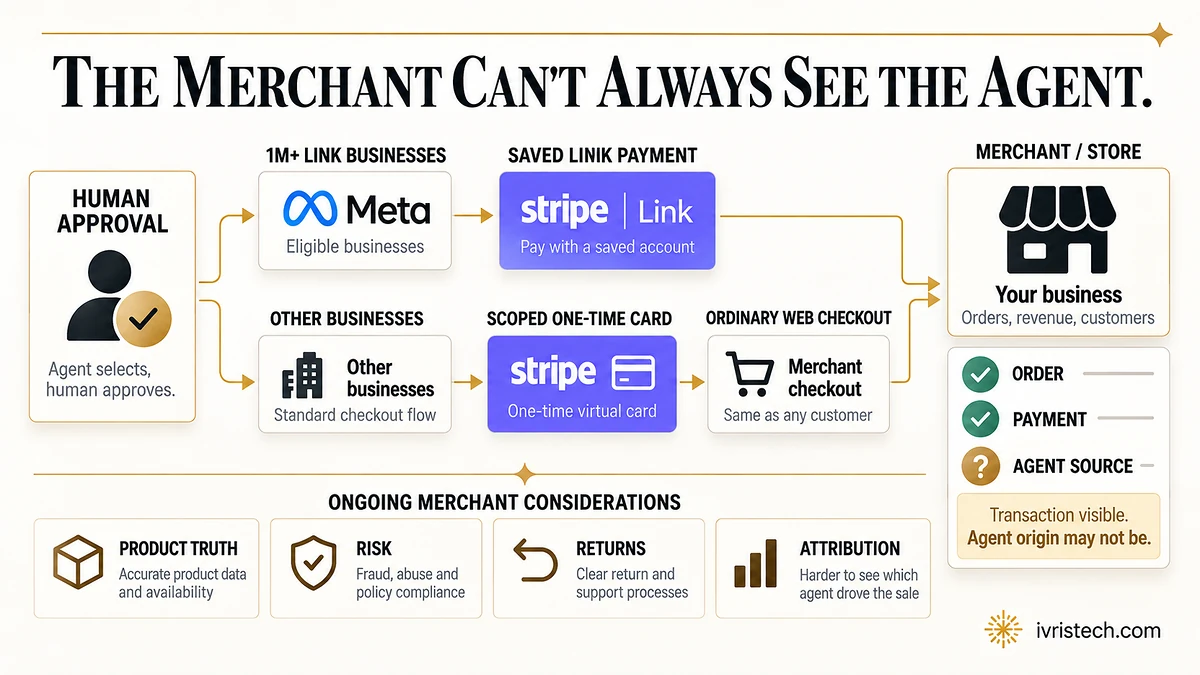
Stripe says US consumers can connect Link to Muse. At more than 1 million businesses that already accept Link, Muse can use the consumer’s saved Link payment method. At other businesses, Link can issue Muse a single-use virtual card scoped to the approved purchase. The consumer still approves the transaction total in chat before payment proceeds.
For ecommerce operators, the question is no longer only whether the store joined an agent-commerce network. It is whether the store can present reliable product data, accept the payment, handle the order and return, and identify what happened in its own measurement stack.
Direct answer: What does Meta Muse’s Stripe Link checkout change for merchants?
Muse can use Link directly at more than 1 million Link businesses and can use a scoped single-use virtual card at other businesses after the user approves the purchase. That means agent-driven checkout can potentially reach a merchant without a dedicated agent integration. The merchant still needs accurate commerce data, working risk controls, post-purchase operations, and a way to measure orders it may not be able to identify as Muse-originated.
Key Takeaways
- Muse is rolling out in the US on iOS, Android, and muse.ai, and Meta requires approval before sensitive actions such as purchases.
- Stripe separates two payment paths: saved Link payment methods at 1M+ Link businesses and a scoped single-use virtual card at other businesses.
- The second path lowers the need for a merchant-specific agent payment integration, but it does not guarantee that every checkout flow will work.
- Meta and Stripe’s launch materials do not disclose a merchant-facing Muse order identifier, referral field, or attribution standard.
- Shop Pay is not live in the launch announcement. Meta says it is coming soon.
What Meta and Stripe Actually Changed
Muse is a browser-using personal agent that can fill forms and act on a person’s behalf. Meta says it checks with the person before purchases and shows an audit trail. Muse does not receive the consumer’s underlying card details; Link handles the payment credential and can generate a one-time card.
The two Link paths matter. A Link merchant participates through a native wallet flow. Another business may still receive a Muse-mediated purchase through a virtual card. Stripe says the card is scoped to the approved purchase; it does not say every checkout or fraud stack is guaranteed to accept it.
Meta also says Shop Pay is coming soon, alongside 1Password support. Those are future capabilities in the current announcement, not part of the live Link integration.
The Merchant Integration Boundary Just Moved
IVRIS’s September 3 analysis of Anthropic’s Shopify commerce-agent reference examined a different control model: the reference storefront builds a cart and hands payment to Shopify, while merchant writes follow a staged approval path. Muse adds another pattern. The agent can arrive through an ordinary browser session and, for a merchant outside Link’s native acceptance network, present a scoped virtual card at checkout.
That creates a merchant visibility gap: a store may receive an agent-driven transaction before it has a reliable way to identify the agent. Neither Meta’s launch post nor Stripe’s Muse announcement specifies a merchant-side Muse referral field, order flag, or analytics standard. Operators should not assume a clean agent segment exists until their own processor, analytics, and checkout logs show one.
The same issue makes agentic-commerce readiness less abstract. Product data, price, inventory, shipping, and policy consistency matter even when the payment rail reaches the merchant without a protocol integration.
What Merchants Need to Audit Before Agent Orders Scale
- Product truth. Compare the product page, structured data, feed, inventory, price, variants, shipping, and return policy for high-value SKUs.
- Checkout compatibility. Test browser and guest checkout, form labels, account requirements, and processor behavior when a legitimate single-use virtual card is presented. Do not weaken fraud controls just to make an agent pass.
- Fraud and exception handling. Ask the processor which signals are available for virtual-card transactions and whether existing rules create false declines. Measure before changing thresholds.
- Returns and support. Link advertises protections for eligible purchases. Document how return, cancellation, fulfillment, and support workflows behave when checkout was delegated to an agent.
- Attribution. Establish a baseline for referral, session, checkout, payment, and order data now. If Muse-originated orders cannot be explicitly segmented, preserve the raw fields you already receive rather than inventing an agent label after the fact.
Those checks extend the plumbing in the IVRIS B2B ecommerce operations guide: synchronized product data, inventory, pricing, payments, and backend systems matter even more when the buyer interface is an agent.
What the Launch Does Not Prove
It does not prove that Muse can complete every checkout on the open web. Stripe says Link can issue a single-use virtual card for other businesses, but successful purchase completion can still depend on the merchant’s checkout, risk controls, inventory state, forms, and other site behavior.
It also does not prove that agent-driven orders will improve conversion, reduce fraud, lower return rates, or create incremental revenue for merchants. Meta and Stripe provide capability and protection claims, not independent merchant ROI evidence.
Our read: the durable change is that merchant participation can become indirect. A payment rail can bring an agent to a normal checkout before the merchant chooses an agent protocol or builds agent-specific analytics. The first job is observability: know what the agent sees, what the payment stack accepts, what the order system records, and what remains invisible.
Frequently Asked Questions
Stripe says that for businesses outside the more than 1 million that accept Link, Link can issue Muse a single-use virtual card scoped to the approved purchase. That expands potential reach beyond Link-native checkout, but the announcement does not guarantee that every merchant’s checkout and fraud controls will accept the transaction.
Yes, under Meta’s launch description. Muse checks with the person before sensitive actions such as making a purchase. Stripe also says the consumer approves the transaction total directly in the chat before the purchase proceeds.
No. Meta’s September 8 announcement says Shop Pay is coming soon as another way to pay. The live payment integration described by Meta and Stripe is Link. Merchants should not treat Shop Pay support as a current Muse capability until Meta or Shopify changes that status.
Start with existing referral, session, checkout, processor, and order data, and ask your payment provider what can be segmented for agent-issued virtual cards. Meta and Stripe’s launch materials do not specify a merchant-facing Muse attribution field, so teams should preserve observable evidence rather than assume a dedicated agent channel already exists.