Anthropic Commerce Agents launched on September 2, 2026 as an open blueprint for shopping and merchant agents built with Claude. The reference patterns cover product discovery, comparison, carts, customer questions, merchant analysis, inventory alerts, pricing and promotion proposals, and campaign drafting.
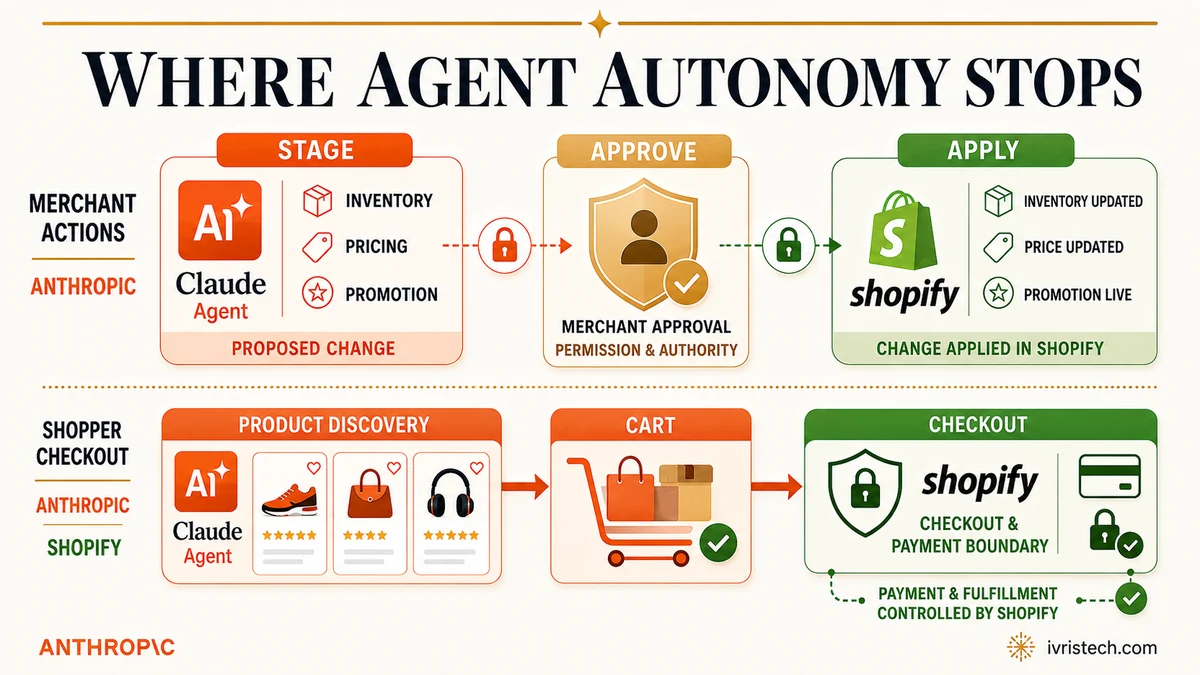
Shopify’s accompanying implementation shows where that autonomy stops by default. Merchant writes follow a stage → approve → apply path — the agent can prepare a change, but staging sends no Shopify Admin mutation, and the host application must grant approval before the write is attempted.
The shopper example draws a second line. It can search a live Shopify catalog and build a real cart, but it hands the buyer to Shopify checkout rather than taking payment itself — a choice in this reference implementation, not the maximum capability of Shopify’s Universal Commerce Protocol. Meta’s Muse and Stripe Link checkout path now shows a different boundary: Stripe can issue a scoped single-use virtual card at other businesses, so agent-driven payment does not always begin with a merchant integrating an agent checkout protocol.
Direct answer: How much authority do Anthropic Commerce Agents get in Shopify’s reference implementation?
The agents can research, recommend, stage merchant changes, and prepare a shopper’s cart and checkout. In Shopify’s merchant example, a separate host approval is required before a staged Admin write is applied. In the storefront example, payment stays on Shopify’s checkout page, although eligible UCP agents can support direct checkout completion in other implementations.
Key Takeaways
- Anthropic’s blueprint includes separate shopping and merchant agents, with reusable skills and safety patterns.
- Shopify’s merchant example keeps write authority outside the chat: stage creates a preview, host approval grants permission, and apply rechecks guardrails before mutation.
- An approval typed into the merchant chat does not, by itself, authorize the change in Shopify’s default example.
- The storefront example never calls
complete_checkout; it hands the buyer to Shopify for checkout, shipping, and payment. - That handoff is example-specific. Shopify documents direct completion for eligible agents with the required purchase permission.
What Anthropic Actually Shipped
Anthropic describes Commerce Agents as a blueprint rather than a finished retail product. It includes reference shopping and merchant agents. The shopping side can search, compare, plan purchases, answer policy questions, and work with carts; the merchant side can analyze performance, flag inventory issues, propose pricing or promotions, and draft campaigns.
The safety boundary matters more than the feature list. Anthropic’s safety documentation says merchant guardrails are checked at staging and again at apply. Host approval is on by default in the reference flow, while authentication, authorization, business rules, approval surfaces, and payment handling remain deployment responsibilities.
Anthropic says retailers using Claude shopping agents have seen carts up to 35% larger and shoppers 60% more likely to complete a purchase. Those are company-reported outcomes, not independent benchmarks. Our read: the more durable evidence in this launch is the operating model — where authority is deliberately separated from the model’s ability to recommend an action.
Shopify Turns Merchant Writes Into Stage → Approve → Apply
Shopify’s merchant reference makes that separation concrete. A stage_* tool reads the current store state, builds a preview, runs guardrails, and records the proposed change. Shopify says every staging path is tested to send zero Admin mutations.
The operator-facing host then presents the preview and calls the apply route. That host action marks the change as approved only for the call. The apply step rechecks guardrails against the current configuration before sending the mutation. If the agent tries to call apply_change itself, the default gate holds it.
The approval state lives outside the model. Typing “approve the restock” in chat does not create the host approval mark, so the same agent that proposed the change cannot talk itself into write authority.
That distinction extends an issue IVRIS has already covered in Shopware’s agentic-commerce architecture: callable commerce actions matter only when permissions and approval paths survive the move from interface clicks to agent tools.
Checkout Is a Handoff Here, Not Shopify’s Maximum Capability
Shopify’s storefront example connects Claude to a live catalog, lets it build a cart, and creates a UCP checkout. It then sends the buyer to the store’s continue_url. The repository explicitly says it never calls complete_checkout because this example does not place the order or take payment.
It would be wrong to turn that reference choice into a Shopify-wide limitation. Shopify’s UCP documentation says eligible agents can complete checkout directly. Shopify also documents that complete_checkout requires the appropriate token permission; signed and anonymous tiers cannot use it. Escalation can still send the buyer back to the merchant when review or interactive input is required.
This also sharpens a point from our agentic-commerce forecast analysis: influencing discovery or preparing a transaction is not the same as autonomously completing every purchase.
What Commerce Teams Should Test Before Giving More Authority
- Separate recommendation from authorization. Record which system, not which model message, grants permission to change price, inventory, promotion, or campaign state.
- Recheck at execution. A staged proposal can become unsafe if inventory, price, policy, or approval limits change before apply.
- Define the payment boundary. Decide when the buyer must review on the merchant surface and when an eligible agent may complete checkout on the buyer’s behalf.
- Keep credentials out of model context. Shopify’s example keeps Admin and buyer tokens in the host rather than exposing them to the model.
- Measure outcomes separately. Track conversion, correction rates, rejected writes, escalations, disputes, and support load before treating vendor-reported cart or completion gains as your benchmark.
Commerce agents are becoming capable enough to prepare real commercial actions. The implementation question is therefore no longer whether an agent can call a tool. It is whether the system around that tool preserves merchant policy, buyer consent, and an auditable path from proposal to execution.
Frequently Asked Questions
Anthropic Commerce Agents are open reference patterns for building Claude-powered shopping and merchant agents. The blueprint includes skills for discovery, comparison, carts, customer care, merchant analysis, inventory, pricing, promotions, and campaigns. It is reference code and architecture that companies adapt to their own systems and controls.
The agent first stages a proposed merchant change without sending a Shopify Admin mutation. The host application shows the preview to an operator and grants approval. Apply then rechecks the configured guardrails before sending the write. Under the default gate, approval typed only in chat does not authorize execution.
Not in Shopify’s Claude reference storefront. That example builds a cart and UCP checkout, then hands the buyer to Shopify’s hosted checkout for the transaction. Shopify’s broader UCP supports direct checkout completion for eligible agents with the required permission, so the sample handoff is not a protocol-wide restriction.
Human or host approval is the default safety pattern in the reference implementation, not a universal rule that every deployment must preserve unchanged. Anthropic makes deployment teams responsible for authorization and business rules. Any move toward greater autonomy should therefore be a deliberate policy decision with equivalent enforcement and auditability.