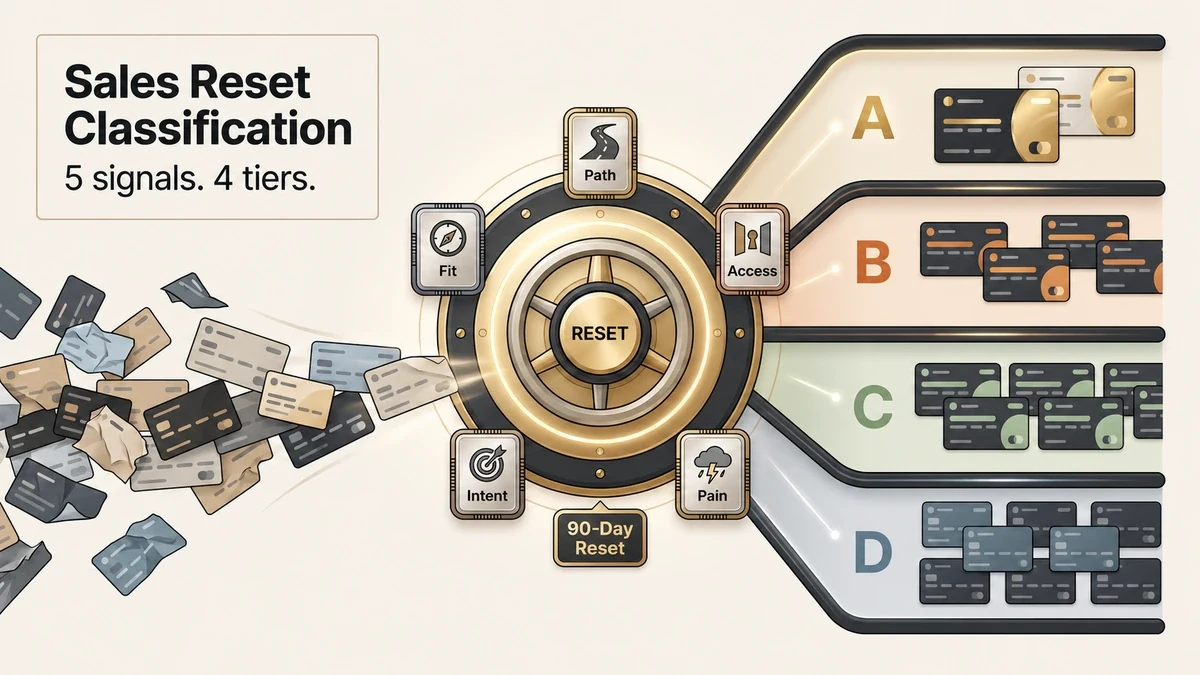
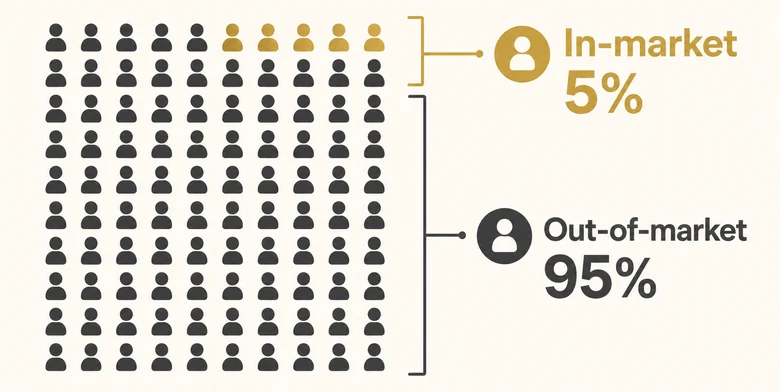
Only about 5% of your potential B2B buyers are in the market to buy right now. The other 95% are not, and they will not be for months or even years. Yet most sales teams still work their entire account list as one undifferentiated pile, top to bottom, then wonder why win rates sag and reps burn weeks on accounts that were never going to close.
B2B sales reset classification criteria are the rules you use to periodically re-rank your whole book of accounts by fit, intent, and buying readiness, then sort them into action tiers so reps spend their hours where deals can actually close. A reset is not a one-time scoring setup. It is a scheduled re-classification of every account against criteria you trust.
This guide gives you the five classification signals, a weighted scorecard you can copy, the A/B/C/D tiers that decide who gets a call, and the six-step process to run a reset in an afternoon.
Key Takeaways
- A sales reset classification re-ranks your entire account base on a schedule, instead of scoring leads one at a time as they arrive.
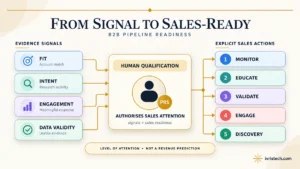
- Five signals decide an account’s class: Fit, Intent, Access, Pain, and Path. Fit and Intent set the baseline; Access, Pain, and Path confirm a deal can actually move.
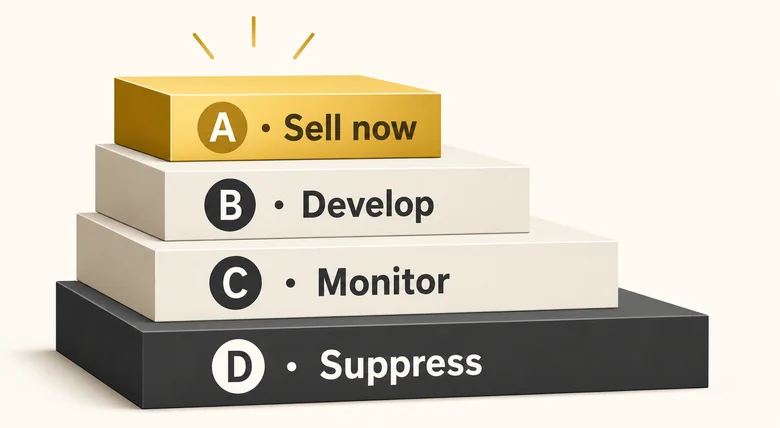
- Scores roll up into four tiers. Tier A gets sales now, Tier B gets developed, Tier C gets monitored, and Tier D gets suppressed or recycled.
- Only about 5% of B2B buyers are in-market in any quarter (the 95:5 rule), so a reset is mostly about finding the few accounts whose intent just turned on.
- Run the reset quarterly. Buying committees, budgets, and intent shift fast enough that a classification more than 90 days old is usually wrong.
What Are B2B Sales Reset Classification Criteria?
B2B sales reset classification criteria are the standards a revenue team uses to re-evaluate and re-rank every account it is pursuing, sorting prospects into priority tiers based on fit, buying intent, and deal readiness. They turn a flat list of leads into a ranked portfolio that tells reps where to spend the next 90 days.
The phrase borrows from the wider “sales reset” idea that gained traction after Concentrix published its Great Sales Reset research, which argued that legacy sales habits no longer match how modern buyers purchase. Classification is the part of that reset you can run yourself, without re-hiring a team: re-decide who is worth selling to, and how hard.
A Reset Is Not One-Time Lead Scoring
Lead scoring runs continuously, adding or subtracting points as each new lead acts. A classification reset is a periodic, portfolio-wide event: you stop, re-score the whole list at once against current criteria, and re-tier everyone together. Scoring keeps the queue fresh day to day. The reset corrects the drift that scoring alone never catches, because a lead scored against last year’s profile keeps its stale rank until something forces a recount. Your underlying lead scoring criteria still feed the reset; the reset is just the moment you apply them to everyone at once.
Why Classifications Go Stale
Two forces rot a classification. First, accounts move: a quiet account turns in-market, a hot one signs with a competitor, a champion changes jobs. Second, your own definition of a good account improves as you close more deals. Professor John Dawes of the Ehrenberg-Bass Institute found that only about 5% of business buyers are in-market in a given quarter, so the small group that matters keeps changing membership. A classification set six months ago is ranking a market that no longer exists.
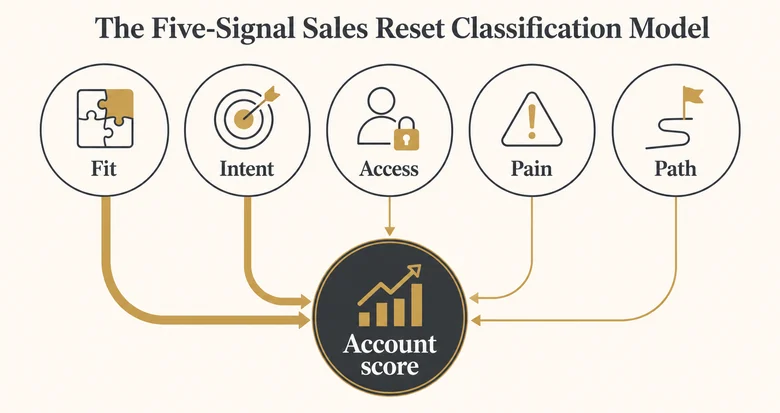
The Sales Reset Classification Model: 5 Signals
The Sales Reset Classification Model scores every account on five signals: Fit, Intent, Access, Pain, and Path. Each signal answers one question a rep needs settled before committing time, and together they separate accounts that look busy from accounts that can actually buy.
Weight the signals to match your motion. The weights below are a starting point for a typical mid-market B2B team. Calibrate them against your own closed-won and closed-lost data, the same way you would tune any scoring model.
Signal 1: Fit
Fit measures how closely the account matches your ideal customer profile: industry, size band, region, and the technology already in place. Fit is the gate. An account that fails fit cannot earn its way into Tier A on intent alone, because engagement from the wrong company is just noise. This is the same account-level test that your lead validation criteria apply at the form, carried up to the whole-portfolio level.
Signal 2: Intent
Intent measures whether the account is showing live buying behavior, from first-party actions like pricing-page visits and demo requests to third-party research surges picked up by intent tools. Intent is where the 95:5 rule bites: most accounts show none, and the reset exists mainly to surface the few whose intent just switched on. Treat a single signal with caution and look for two or more before you promote an account.
Signal 3: Access
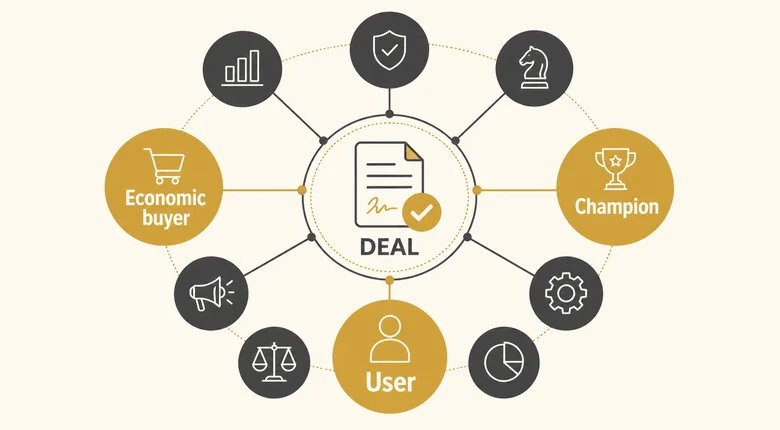
Access measures whether you can actually reach the people who decide. A modern B2B purchase runs through a buying group of six to ten people, according to Gartner’s B2B buying research, so a single friendly contact is not access. Score access on how many roles you have mapped and engaged: an economic buyer, a champion, and at least one end user beats one warm coordinator every time. A high Access score really just means you have mapped the buying committee you actually need to reach, because the roles you have not engaged are the ones that quietly sink the deal.
Signal 4: Pain
Pain measures whether the account has a problem your product solves and whether anyone there has put a number on it. A documented, quantified problem (“we lose 40 hours a week to manual reporting”) predicts a deal far better than vague interest. No named pain means no urgency, and no urgency means the account stays in a lower tier no matter how clean the fit looks.
Signal 5: Path
Path measures whether there is a credible route to a decision: a timeline, a budget owner, and a defined next step. This is the exit-criteria discipline of a good sales process, applied at classification time. An account with fit, intent, access, and pain but no path is real, but it is not this quarter’s deal, and your tiers should say so.
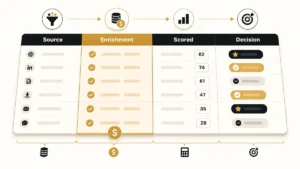
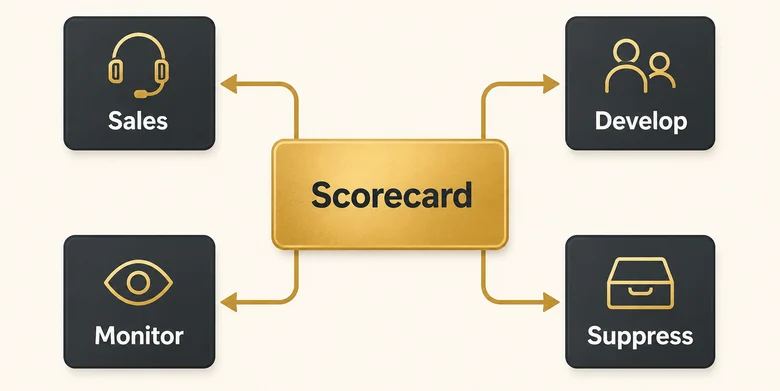
The scorecard turns the five signals into one number per account. Rate each signal from 0 to 3, multiply by its weight, and sum the results.
Account score = Σ (signal rating × signal weight), each signal rated 0 to 3| Signal | What to measure | Primary data source | Weight | What a 3 looks like |
|---|---|---|---|---|
| Fit | ICP match: industry, size, region, tech | CRM + enrichment | ×3 | On the target list, inside every ICP band |
| Intent | First-party and third-party buying signals | Web analytics + intent platform | ×3 | Two or more live signals in 30 days |
| Access | Buying-committee roles mapped and engaged | CRM contacts + sales notes | ×2 | Economic buyer, champion, and a user engaged |
| Pain | Documented, quantified problem | Discovery notes | ×2 | A named pain with a number attached |
| Path | Timeline, budget owner, next step | Opportunity record | ×2 | Confirmed timeline and a scheduled next step |
The maximum score is 36: each signal at 3, times its weight, summed (9 plus 9 plus 6 plus 6 plus 6). Where the cut lines fall is your call, but the bands in the next section are a workable default.
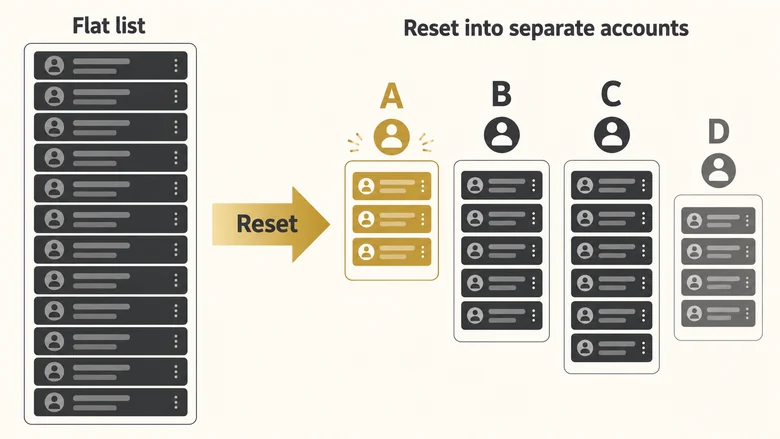
The A/B/C/D Account Tiers
Account tiers are the output of the classification: each account lands in Tier A, B, C, or D based on its scorecard total, and each tier carries a fixed action so the ranking actually changes what reps do. A classification that does not route is just a spreadsheet.
| Tier | Score band (of 36) | What it means | Action | Owner |
|---|---|---|---|---|
| A | 26 and up | Right fit, live intent, reachable, real path | Active selling now | Sales / AE |
| B | 18 to 25 | Strong fit, intent still warming | Develop and multi-thread | SDR + marketing |
| C | 10 to 17 | Fits, but no live intent yet | Monitor, keep warm | Marketing |
| D | Below 10, or any hard-negative | Poor fit or disqualifying signal | Suppress or recycle | Marketing ops |
Tier D is where a reset pays for itself. These accounts drain attention they do not deserve, and the discipline of negative lead scoring is what pushes a poor-fit or disengaged account down here instead of letting it ride a stale high score. Recycle the ones that might return, and hard-exclude competitors and bad data for good.
Notice that Tier B and Tier C both fit your ICP. The only difference between them is intent. That distinction is the same one that separates a marketing-qualified lead from a sales-qualified one, covered in our MQL vs SQL guide, applied here at the account level instead of the individual lead.
How to Run a B2B Sales Classification Reset
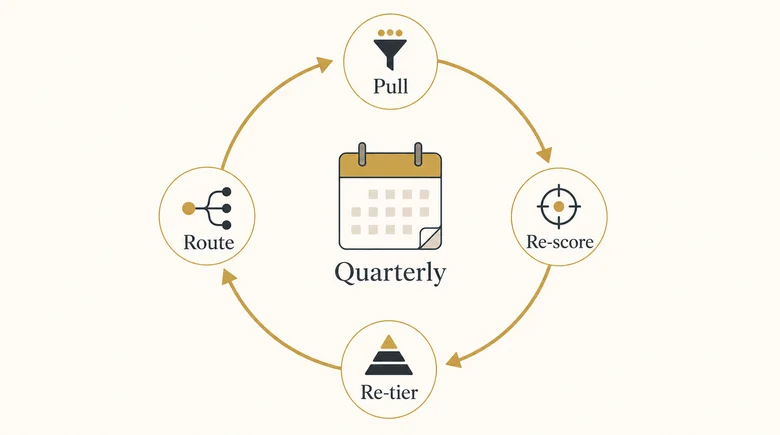
To run a sales reset, pull your account list, re-derive your ICP from recent wins, score every account on the five signals, assign tiers, route by tier, and set the date for the next reset. The whole pass takes an afternoon once your data sits in one place. If your ICP itself is fuzzy, fix that first with a clear go-to-market strategy, because every tier below depends on a fit definition you actually believe.
Workflow · 2 hr
How to run a B2B sales classification reset
Re-rank every account on five signals and route each tier to the right team in one scheduled pass.
Pull and clean the account list
Export every open and target account from your CRM, merge duplicates, and refresh enrichment so the fit data is current before you score anything.
Re-derive your ICP from recent wins
Pull your last two to four quarters of closed-won deals and confirm the industry, size, and traits they share. This is the fit standard for this reset, not last year’s.
Score every account on the five signals
Rate Fit, Intent, Access, Pain, and Path from 0 to 3, apply the weights, and record one total per account in a dedicated reset column.
Assign A, B, C, and D tiers
Apply your score bands so each account gets a tier, and send any hard-negative account straight to D regardless of its total.
Route each tier to its owner
Send Tier A to AEs for active selling, Tier B to SDRs and marketing to develop, hold Tier C in a warming track, and move Tier D to suppression or recycling.
Set the next reset date and exit criteria
Book the next quarterly reset now, and write down the signal that moves an account up or down between resets so the tiers stay honest in the meantime.
Mapping the Criteria to the Buying Committee and the 95:5 Reality
Two market facts shape every classification: most accounts are out of market, and the few that are in market buy as a group. The criteria above are built around both, which is why Intent and Access carry the heaviest weight.
The 95:5 rule, drawn from Ehrenberg-Bass research, holds that roughly 5% of B2B buyers are ready to buy at any one time. For classification, that means the goal is not to score everyone highly. It is to keep 90% to 95% of your list in Tier C, correctly waiting, so the 5% in Tier A and B stand out instead of drowning.
IMPORTANT
A reset that promotes most of your list to Tier A has failed. If everything is a priority, nothing is. Healthy resets leave the large majority of accounts in the monitor tier and move only the few with live intent up.
Access carries weight because buying groups have grown. With six to ten stakeholders on a complex deal, each arriving with their own research, a single contact cannot carry a purchase. Gartner has also found that 74% of B2B buying teams show unhealthy conflict during the decision, so an account where you have mapped and aligned several roles is far more likely to close than one where you know a single enthusiast.
How Often Should You Reset Your Classification?
Run a full B2B sales classification reset once a quarter. Ninety days is short enough that intent data and buying-committee changes have not made the tiers meaningless, and long enough that reps are not whipsawed by constant re-ranking. When a reset lifts an account into your top tier, the follow-through is a full committee-selling motion, because the six to ten people who moved that account’s priority are the same group a rep now has to win one by one.
Between quarterly resets, let your live scoring handle day-to-day movement, and trigger an off-cycle reset only on a real shock: a pricing change, a new product, a market event, or a sharp move in close rates. The quarterly cadence pairs with the recalibration rhythm in our lead scoring best practices, so you can re-tier accounts and retune the model in the same sitting.
PRO TIP
Run your classification reset in the last week of the quarter, alongside pipeline review. The data is already on the table, leadership is already looking at the numbers, and the new tiers go live with the new quarter’s plan.
Tie the reset to your operating rhythm so it never gets skipped. A team that already runs a tight revenue-operations cadence has the meeting and the data in place, which makes the reset one more agenda item rather than a new project.
Sales Reset Classification vs. Lead Scoring, BANT, and MEDDIC
Classification does not replace lead scoring or qualification frameworks. It sits above them and uses their output. The difference is the unit of work and the cadence: scoring ranks individual leads continuously, qualification frameworks vet a single deal in a conversation, and a reset re-ranks the whole account portfolio on a schedule.
| Approach | Unit | Question it answers | Cadence |
|---|---|---|---|
| Lead scoring | Individual lead | How hot is this lead right now? | Continuous |
| BANT | Single deal | Budget, Authority, Need, Timeline present? | Per conversation |
| MEDDIC | Single deal | Is this complex deal qualified and winnable? | Per opportunity |
| Validation gate | Inbound lead | Is this lead real and reachable? | On capture |
| Sales reset classification | Whole account portfolio | Where should the team spend the next 90 days? | Quarterly |
The pieces stack. Validation keeps junk out, scoring ranks the survivors, qualification frameworks pressure-test the live deals, and the reset steps back once a quarter to re-rank everything together. If your stages are not mapped yet, settle those first with the B2B sales funnel stages, because a classification re-ranks accounts within a funnel, it does not replace one.
Tools to Run a Classification Reset
You can run a reset in a spreadsheet, but three tool categories make it repeatable: your CRM holds the accounts and tiers, an intent platform supplies the Intent signal, and an enrichment source fills the Fit data. Pick the ones that fit your stack rather than adding new vendors for the sake of it.
Whichever tools you choose, keep the scorecard visible to reps inside the CRM. A tier nobody can see or question is a tier nobody trusts, and a classification reps ignore is worse than no classification at all, because it adds work without changing where the selling happens.
Frequently Asked Questions
They are the standards a sales team uses to periodically re-rank every account by fit, intent, access, pain, and a credible path to a decision, then sort accounts into A, B, C, and D tiers. The criteria turn a flat lead list into a ranked portfolio that tells reps where to focus for the next quarter.
The 95:5 rule, from John Dawes at the Ehrenberg-Bass Institute, holds that only about 5% of B2B buyers are in-market and ready to buy at any one time, while 95% are not. It is why a classification reset focuses on surfacing the small in-market group rather than scoring every account highly.
The 3-3-3 rule is a follow-up cadence: make three contact attempts, across three channels, over roughly three weeks before you pause a prospect. A different version frames it as three seconds to hook, three minutes to add value, and three touches to earn a reply. Both are outreach disciplines, not classification criteria.
The rule of 7 is a marketing maxim that a buyer needs to encounter your message about seven times before acting. In B2B, where only a small share of accounts are in-market at once, it explains why staying visible to out-of-market accounts in your Tier C matters as much as chasing the in-market few.
The 2-2-2 rule is a post-sale follow-up rhythm: check in at two days, two weeks, and two months after a purchase to confirm onboarding, drive adoption, and open expansion. It applies after a deal closes, so it sits downstream of classification, which decides who you pursue in the first place.
Run a full reset quarterly. Ninety days is long enough to avoid whipsawing reps and short enough that intent shifts and buying-committee changes have not made your tiers wrong. Trigger an extra reset only on a real shock, such as a pricing change, a new product, or a sharp move in close rates.
A sales reset classification is the discipline of asking, every quarter, a question most teams answer only once: who is actually worth selling to right now? Score the five signals, set the tiers, route the work, and book the next reset. Done on a schedule, it keeps the accounts that can close this quarter from hiding inside the 95% that cannot.