Search data enrichment tools and count how many of the ranking pages are published by a company that sells enrichment. On the US desktop result we captured on 2 August 2026, the answer is nearly all of them. Zapier ranks first and lists itself eleventh. Cleanlist ranks third and ranks itself first. Alation ranks sixth and positions itself as the layer the other five need. LeadAngel, sitting at position 63 on this term but at 16 on lead enrichment, ranks itself first too.
Two of the top ten organic results are not articles at all. They are a Reddit thread and a HubSpot Community thread, followed by a whole “Discussions and forums” block carrying three more. Buyers are routing around the listicles, and it is not hard to see why.
The deeper problem is not bias. It is that the numbers these pages compare are not comparable. Almost every vendor publishes a coverage or accuracy figure. Almost none publishes the denominator: matched against which population, in which regions, at what confidence threshold, verified how recently. This page grades nine tools on exactly that, and gives you a method for producing the only number that should decide a purchase, which is the one you measure on your own list.
Direct answer — What are the best data enrichment tools for CRM accuracy?
Data enrichment tools fill missing or stale fields on CRM records using external data. The strongest options for CRM accuracy in 2026 are ZoomInfo, Apollo.io, Clay, Cognism, HubSpot Breeze Intelligence, Snov.io, FullContact, Demandbase and Cleanlist. No published match rate is comparable across vendors, because each defines the metric differently and rarely states the population it was measured against. Measure fill rate and accuracy on a sample of your own records during a trial.
Key Takeaways
- Database size is not a match rate. A vendor holding 500 million contacts tells you nothing about whether your 5,000 records get matched.
- Demandbase, a vendor in this category, has published that “match rate” has at least five incompatible definitions and that buyers should not weight it heavily in a purchase decision.
- We grade disclosure, not product quality. NV means we could not verify it on the vendor’s own pages on 6 August 2026, never that the capability is absent.
- Snov.io and ZoomInfo disclose the most of the nine. Cognism and Apollo.io disclose the least, though for opposite reasons.
- Clearbit is no longer a standalone product. Pages still recommending it as one are describing something you cannot buy that way.
- The enrichment coverage test in this article produces a defensible number in about two hours using a 200-row sample of your own records.
What counts as a data enrichment tool
A data enrichment tool is software that adds or corrects fields on records you already hold, using data sourced from outside your systems. That definition excludes a lot of what gets listed under this keyword, which is part of why the comparisons read strangely.
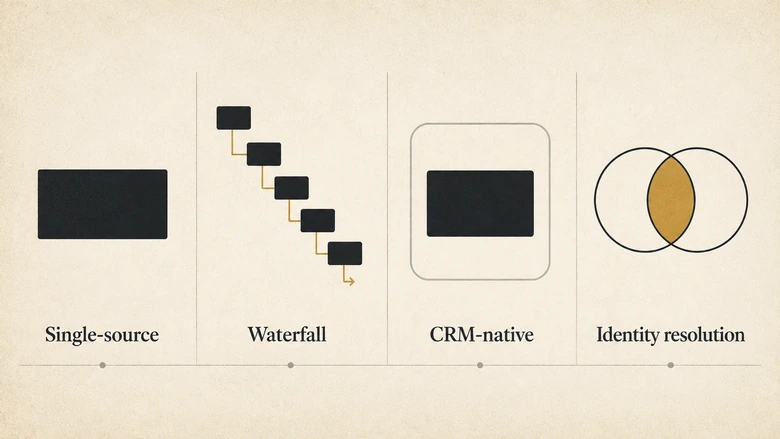
Four product shapes hide behind the one search term, and comparing across them is a category error rather than a comparison. We cover what enrichment is, where the data comes from and how the workflow runs in our guide to B2B data enrichment, so this page stays on the buying decision.
| Shape | What it does | Buy it when | Avoid it when |
|---|---|---|---|
| Single-source database | Matches your records against one proprietary dataset | Your ICP sits squarely inside the vendor’s strongest coverage region | You sell across regions or into SMBs, where one source thins out |
| Waterfall orchestration | Queries providers in sequence until a field fills | Fill rate matters more than a single vendor relationship | You need one auditable provenance trail per field |
| CRM-native enrichment | Enriches inside the CRM you already run | You want write-back control and no integration surface | You need the same data outside that CRM |
| Identity resolution | Resolves duplicate or partial identities into one profile | Your problem is duplicate people, not missing fields | Your records are unique but incomplete |
Why every coverage number in this category is unfalsifiable
A coverage percentage without a denominator is not a measurement. It is a claim shaped like one. The clearest statement of this problem comes not from a critic but from a vendor.
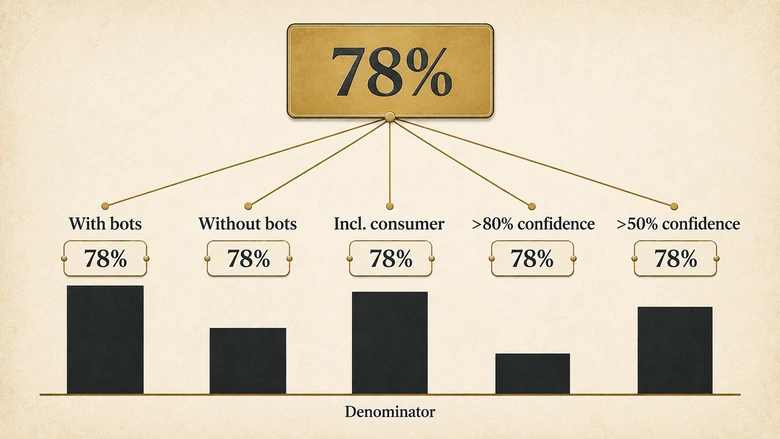
In May 2025, Demandbase’s then Director of Product Marketing published an article on match rates that lists five different things the term can mean: the share of traffic matched to a business after removing bots, the same before removing bots, the share matched to businesses and consumers and bots together, the share above an 80% confidence score, and the share above a 50% confidence score. His conclusion about comparing two vendors on those figures was that “it would not be an apples-to-apples comparison.”
Every vendor can appear to have the highest match rate by simply tweaking their match rate definition.
He went further, noting that vendors using a customer-facing confidence score “can easily move the lever to artificially inflate the match rate percentage whenever they want,” and that a buyer testing against their own first-party data is testing a biased sample, because that data “likely has more established companies with a larger digital footprint.” His recommendation was blunt: do not put much weight on a vendor’s match rate when making a purchasing decision.
That article is about account identification from web traffic rather than contact enrichment, and the two are different measurements that should never be averaged together. What transfers is the structure of the problem, not the numbers. Our reading is that all four failure modes he describes apply equally to enrichment fill rates, and nothing on the current SERP suggests otherwise.
What a credible coverage claim would contain
Five disclosures turn a marketing percentage into something a buyer can check:
- The population. Which records were matched: how many, from which regions, at what company sizes.
- The field. Email coverage, direct-dial coverage and firmographic coverage are separate numbers and behave differently.
- The definition of a match. Returned a value, or returned a value that was independently verified.
- The threshold. The confidence level below which a result was discarded.
- The date. A coverage figure decays; an undated one is unreadable.
Not one of the nine tools below publishes all five. The most common pattern is a headline percentage attached to none of them.
How we graded these tools
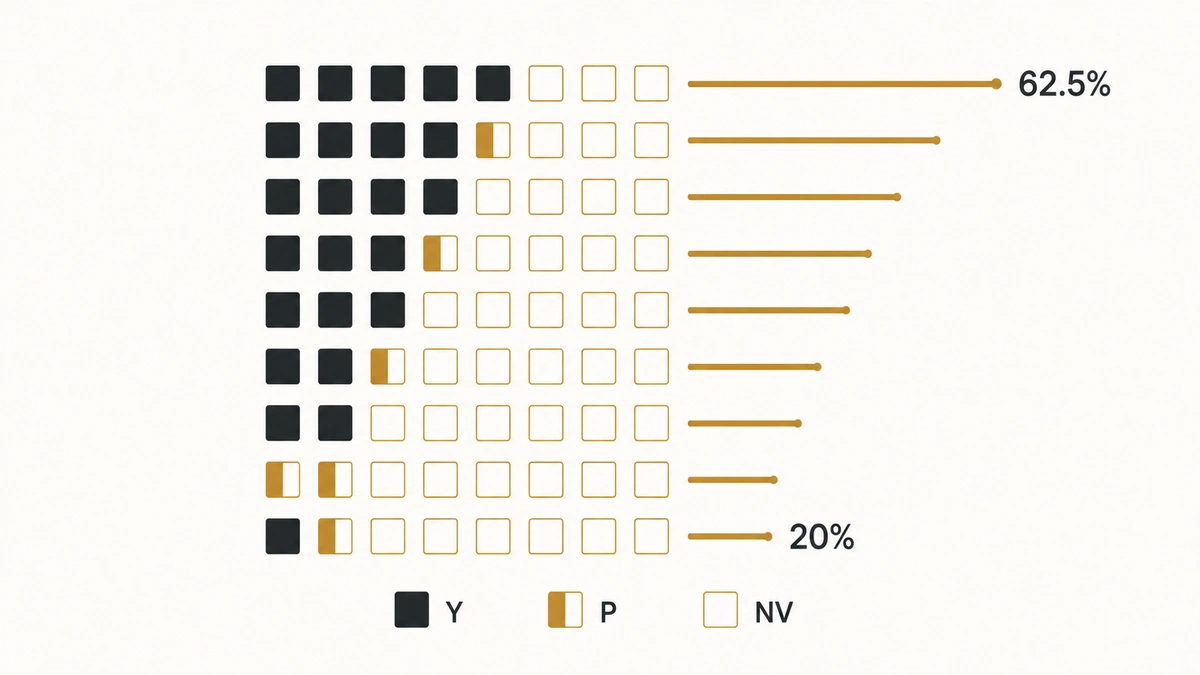
We checked each vendor’s own public pages and recorded what we found against eight criteria, weighted to sum to 100. Every cell is one of three values: Y for published and specific, P for published but qualified or missing a denominator, and NV for not verified on the pages we checked.
| Criterion | Weight | What earns a Y |
|---|---|---|
| Stated match or fill rate | 20 | A specific figure with the denominator attached |
| Population it is measured against | 15 | Sample size, regions and segments named |
| Published pricing | 15 | Actual figures on the vendor’s own pricing page |
| Refresh cadence | 15 | A stated interval or a described continuous process |
| Source transparency | 10 | Where the data comes from, named |
| GDPR and CCPA posture | 10 | Specific statements or named certifications |
| CRM write-back and field control | 10 | Overwrite behaviour per field is documented |
| Decay and re-verification policy | 5 | What happens to a record that goes stale |
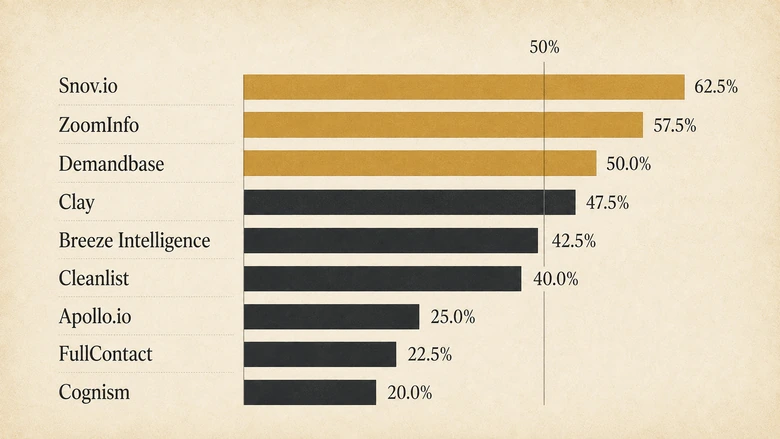
Disclosure coverage % = Σ(criterion weight × factor), where Y = 1.0, P = 0.5, NV = 0What we did not do. We ran no benchmark, bought no seats and tested no match rates. IVRIS has not measured any vendor’s accuracy and does not publish a star rating for any of them. This scorecard measures what each company chooses to disclose in public, which is checkable by anyone with a browser, and deliberately says nothing about which product performs better.
The enrichment disclosure scorecard
Nine tools, graded on the eight criteria above.
| Tool | Shape | Match/fill rate | Population | Pricing | Refresh | Sources | GDPR/CCPA | Write-back | Decay policy | Disclosure coverage |
|---|---|---|---|---|---|---|---|---|---|---|
| Snov.io | Single-source | P | P | Y | Y | NV | P | P | Y | 62.5% |
| ZoomInfo | Single-source | P | P | NV | Y | Y | Y | NV | Y | 57.5% |
| Demandbase | Identity resolution | Y | Y | NV | NV | P | Y | NV | NV | 50.0% |
| Clay | Waterfall | NV | NV | Y | Y | P | P | P | P | 47.5% |
| HubSpot Breeze Intelligence | CRM-native | NV | NV | P | P | P | Y | Y | P | 42.5% |
| Cleanlist | Waterfall | Y | NV | Y | NV | P | NV | NV | NV | 40.0% |
| Apollo.io | Waterfall | NV | NV | Y | NV | NV | P | P | NV | 25.0% |
| FullContact | Identity resolution | P | P | NV | NV | NV | P | NV | NV | 22.5% |
| Cognism | Single-source | NV | NV | NV | P | P | P | NV | P | 20.0% |
Based on publicly available vendor documentation, checked 6 August 2026. NV means not verified publicly on the pages we checked, not absent. Disclosure coverage percentages are IVRIS calculations using the formula above, and measure transparency rather than product quality.
IMPORTANT
A high score here is not a recommendation and a low one is not a warning. Cognism scores 20% largely because it publishes no pricing, which is a commercial choice rather than a data-quality signal. Read the row, not the number.
Single-source databases: ZoomInfo, Cognism, Snov.io
Single-source tools match your records against one proprietary dataset. Coverage is deepest where the vendor has invested and thins predictably outside it, which is why the population disclosure matters more here than anywhere else.
ZoomInfo: best for North American enterprise coverage
What it is: the largest general-purpose B2B database. Best for: teams selling to established North American companies. Stated coverage: its coverage page claims 500 million contacts, 100 million companies, 200 million verified business emails and 120 million direct dials, none carrying a date. Accuracy claim: “up to 95% accuracy on first-party data,” hedged, undated, and scoped to one data type. The same page concedes that accuracy varies by data type and region. Pricing: not published on the pages we checked.
ZoomInfo discloses more than most on the process side. It names five sourcing channels, states that records are continuously re-verified rather than batch-refreshed, and lists ISO 27001, ISO 27701, SOC 2 Type II and TRUSTe GDPR and CCPA certifications. The gap is the denominator on that 95%.
Cognism: best for European coverage and compliance posture
What it is: a B2B database built around phone-verified mobile numbers and European compliance. Best for: teams selling into EMEA. Stated coverage: none on its pricing page. Pricing: not published; every tier routes to a sales conversation. Refresh: described only as “enrich a contact once, and we keep it up to date,” with credits consumed again when details such as a job move change.
Cognism has the strongest reputation in this set for European data and the weakest public disclosure of any vendor we checked. Those two facts sit together uncomfortably, and the second is a marketing decision rather than evidence about the first.
Snov.io: best for small teams that want published numbers
What it is: a lower-cost prospecting and verification platform. Best for: small teams on a fixed budget. Stated coverage: “7-tier email verification” with “98%+ accuracy,” scoped to the verifier rather than the database, and with no sample or date. Refresh: the database is described as reverified monthly, one of only two stated intervals in this set. Starting price (as of Q3 2026): $29.25/month for 1,000 credits, rising to $553.50/month for the Ultra tier.
Snov.io tops the disclosure table, which surprised us. It publishes prices, a refresh interval and a verification figure. What it does not publish is where any of the data originates.
Waterfall orchestration: Clay, Apollo.io, Cleanlist
Waterfall tools query providers in sequence until a field fills, which raises fill rate at the cost of a single clean provenance trail. If you need to know which provider supplied a given value, ask during the trial rather than after.
Clay: best for custom enrichment workflows
What it is: a workflow tool that chains data providers with custom logic. Best for: operators who want to design the waterfall themselves. Stated coverage: none. Clay publishes no match rate at all, which is more honest than publishing one without a denominator. Refresh: source sync runs daily on paid tiers and every 15 minutes on Enterprise. Starting price (as of Q3 2026): free tier at 500 actions per month, Launch at $167/month, Growth at $446/month, Enterprise custom. Clay runs waterfalls across a stated 150+ providers.
Apollo.io: best all-in-one for budget-constrained teams
What it is: enrichment bundled with sequencing, dialling and deal management. Best for: teams consolidating tools. Stated coverage: none on the pricing page. Starting price (as of Q3 2026): free tier at 900 credits per seat per year, Basic at $49 per seat per month billed annually with 30,000 credits, Professional at $79, Organization at $119 with a three-seat minimum. The page notes this is introductory pricing subject to change.
Apollo scores 25% because pricing is the only criterion it fully discloses. Waterfall enrichment and CRM enrichment appear from the Basic tier upward, but no refresh cadence, sourcing statement or field-level control is documented on the pages we checked.
Cleanlist: best disclosed benchmark, with a caveat
What it is: a waterfall enrichment service that publishes its own comparative benchmark. Best for: buyers who want to see a methodology at all. Stated coverage: 98% verified emails and 85% direct dials, from a benchmark it ran itself and in which it places first. Pricing: published, and it publishes approximate pricing for the ten rivals it grades too.
Cleanlist does something none of the other ranking pages do, which is separate vendor-stated figures from measured ones. It still does not disclose the composition of the sample: no ICP definition, no regional split, no industry breakdown. A benchmark in which the publisher finishes first, run on an undisclosed population, is a marketing asset with a methodology section.
CRM-native and identity resolution: Breeze Intelligence, Demandbase, FullContact
HubSpot Breeze Intelligence: best field-level control
What it is: HubSpot’s native enrichment, formerly sold as Clearbit. Best for: teams already standardised on HubSpot. Stated coverage: no match or fill rate, though it indexes a stated 100 million company domains and 380 million email addresses. Pricing: included in paid Smart CRM plans rather than priced separately.
It is the only tool in this set that documents field-level write-back behaviour plainly: mapped fields can be overwritten, kept as is, or left blank. That single sentence resolves the question most enrichment buyers actually lose sleep over, which is whether the tool will quietly overwrite a value a human confirmed.
PRO TIP
Clearbit stopped being a standalone product. HubSpot completed the acquisition in December 2023, rebranded it to Breeze Intelligence, retired self-serve signup for new customers and discontinued the free tools in April 2025. Any 2026 listicle still presenting Clearbit as an independent purchase with a Salesforce path is describing something you cannot buy.
Demandbase: best published definition of its own metric
What it is: an account intelligence platform with enrichment attached. Best for: ABM teams that need account identification as much as record completion. Stated coverage: a global accuracy rate of 92%, published alongside a definition of what it measures, which is the share of accounts identified correctly. Pricing: custom quote only.
Demandbase scores highest on the two disclosure criteria that matter most, and it earns that by publishing the definition rather than only the number. Note the scope: the 92% is account identification, not contact-field enrichment, and the two should not be read as the same measurement.
FullContact: identity resolution with a mismatched denominator
What it is: identity resolution across online and offline records. Best for: resolving duplicate identities rather than filling blank fields. Stated coverage: match rates “up to 85%,” stated for publishers connecting online and offline audience data. Pricing: not published.
That 85% is a worked example of the denominator problem. It is a real figure, published by the vendor, measured against a publisher audience population. It tells a B2B revenue team with a CRM full of stale job titles almost nothing, and it will still get quoted in listicles as though it did.
Also ranking for this keyword, and why they sit outside the matrix
Four names appear across the ranking pages and the AI Overview but are not graded above, for reasons worth stating rather than hiding:
- Lusha. Its pricing and data pages did not return figures to two independent automated reads on 6 August 2026. We do not repeat pricing or accuracy numbers sourced from third-party blogs, so it is excluded rather than graded on hearsay.
- Clearbit. Folded into HubSpot Breeze Intelligence and graded there.
- Datanyze and Pipl. Both appear in competitor listicles, but neither is positioned primarily as a CRM enrichment tool in 2026.
- Bombora and other intent vendors. Intent data answers a different question. If you are weighing that, start with B2B intent data instead.
What data enrichment tools actually cost
Four of the nine publish real figures. The rest route you to a sales conversation, which is a commercial choice rather than a data-quality signal, though it does make budgeting harder.
| Tool | Entry price (as of Q3 2026) | Model |
|---|---|---|
| Snov.io | $29.25/month (as of Q3 2026) | Credit tiers, 1,000 credits at entry |
| Apollo.io | $49 per seat/month billed annually (as of Q3 2026) | Per seat plus annual credit grant |
| Clay | $167/month (as of Q3 2026) | Actions plus data credits |
| Cleanlist | Published | Credit-based |
| HubSpot Breeze Intelligence | Bundled | Included in paid Smart CRM plans |
| ZoomInfo, Cognism, Demandbase, FullContact | Not published | Custom quote |
Budget for a sales call rather than a checkout page on more than half this list. Figures that circulate for the unpublished four trace back to third-party review listings rather than to the vendors, so we do not repeat them.
Enrichment and lead intelligence are not the same purchase
Lead intelligence platforms show up in the same searches and often in the same listicles, which muddies both. The distinction is simple and worth holding onto during a demo.
Enrichment fills fields on records you already have. Lead intelligence adds signals about accounts, including ones not yet in your CRM: who is researching, which pages they read, which accounts resemble your best customers. Demandbase and ZoomInfo sell both. Snov.io and Clay sell mainly the first. Buying a lead intelligence platform to fix stale job titles is an expensive way to solve a cheap problem, and buying an enrichment tool to find in-market accounts will disappoint you.
The same disclosure problem runs through both categories, and arguably worse in intelligence, where the headline metric is account identification and the confidence threshold is usually invisible. Apply the same five questions.
Measure your own match rate
Every figure above describes what vendors publish. This one describes your data, and it is the only number that should decide the purchase.
Workflow · 2 hours
How to measure enrichment coverage on your own data
Produces a fill rate and an accuracy rate for each vendor on a sample of your records, using a denominator you control.
Draw a stratified 200-row sample
Pull 200 records from your CRM, stratified across the regions and company-size bands you actually sell into. Do not sample your best accounts; they match easily and will flatter every vendor.
Build the ground truth
For 50 of the 200, confirm the true current value of each field you care about by hand. This is your answer key and it is the step people skip.
Blank the held-back fields
Strip the fields under test from the input file so each vendor is solving the same problem from the same starting point.
Run every vendor on the identical file
Use the same 200 rows in every trial, on the same day. Different files or different weeks make the results incomparable, which is the failure this whole exercise exists to avoid.
Score fill rate and accuracy separately
Fill rate is values returned divided by 200. Accuracy is correct values divided by values returned, scored against your 50-row answer key. A vendor can win one and lose the other.
Break the score down by segment
Report separately for each region and size band. A single blended number hides the exact weakness that will cost you later.
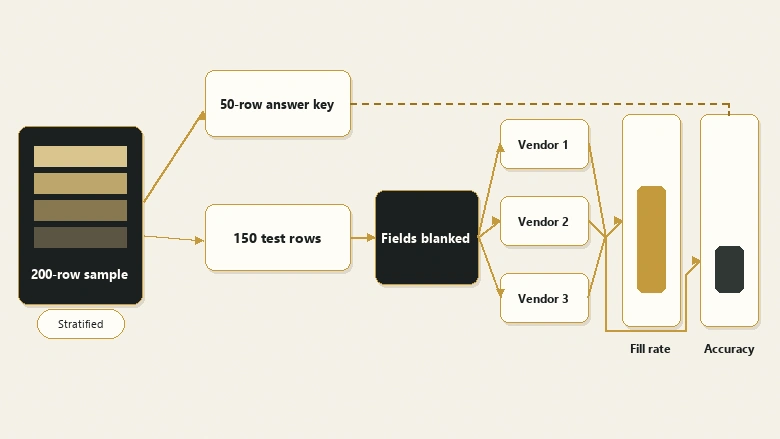
Run this during overlapping trials and you will produce something no vendor publishes: a coverage figure with a denominator, measured on the population you actually sell to, on a stated date. Enrichment is the remediation for records going stale, and the rate at which yours decay determines how often you need to repeat it, which we cover in our analysis of CRM data decay statistics.
DOWNLOAD THE SCORECARD AND TEST METHOD
Both artefacts from this article, free and ungated: IVRIS Enrichment Disclosure Scorecard and Coverage Test Method v1.0 (XLSX) or CSV. Nine vendors across eight criteria with the weights exposed and editable, plus a scoring sheet for your own 200-row trial. Reusable with attribution.
Suggested citation: IVRIS Tech. “Enrichment Disclosure Scorecard.” ivristech.com, 2026. https://ivristech.com/best-data-enrichment-tools/
Which tool to choose
Match the shape of your problem to the shape of the product, then verify with the test above rather than with anyone’s published percentage.
- Use a single-source database when your ICP concentrates in one region. ZoomInfo for North American enterprise, Cognism for EMEA, Snov.io when budget is the binding constraint.
- Use a waterfall when fill rate matters more than provenance. Clay if you want to build the logic, Apollo.io if you want enrichment bundled with outreach.
- Use CRM-native enrichment when you run HubSpot and care about overwrite control more than raw coverage.
- Use identity resolution only when your real problem is duplicate identities. If your records are unique but incomplete, this is the wrong category, and CRM data cleansing services may be closer to what you need.
- Avoid any tool that will not tell you, during the trial, which provider supplied a given field value.
We grade software this way consistently. The same disclosure method drives our comparison of lead routing software, and the criteria tables are deliberately structured alike so the two can be read together.
Frequently Asked Questions
Data enrichment tools add or correct fields on records you already hold, using data sourced from outside your systems. They fill gaps such as job title, company size, industry and direct-dial phone, and refresh values that have gone stale since the record was created.
Several vendors run free tiers rather than free products. Apollo.io grants 900 credits per seat per year at no cost and Clay offers 500 actions per month, both as of Q3 2026. These are large enough to test coverage on a sample, not to enrich a database.
There is no portable answer, because match rate has at least five incompatible definitions and depends entirely on the list being matched. A rate measured on North American enterprise records will beat the same vendor’s rate on European SMB records. Measure it on your own sample.
Cleansing fixes what is already in the record: duplicates, formatting, invalid values. Enrichment adds what is missing or replaces what has gone stale, using external sources. Most CRMs need both, and cleansing first makes enrichment match better.
Of the nine graded here, Snov.io, Apollo.io, Clay and Cleanlist publish figures on their own pricing pages as of Q3 2026. ZoomInfo, Cognism, Demandbase and FullContact route buyers to a sales conversation. HubSpot Breeze Intelligence is bundled into paid Smart CRM plans.
Methodology, sources and revision history
How this was compiled. We read the SERP for data enrichment tools captured on 2 August 2026 for United States English desktop, then checked each graded vendor’s own public pricing, product and coverage pages on 6 August 2026. Cells were scored Y, P or NV against the eight published criteria and weights above. Every figure quoted is attributed to the vendor page it appeared on.
Limitations. This grades public disclosure at a point in time, not product performance. IVRIS ran no benchmark and holds no measured accuracy data on any vendor. Pages we could not retrieve are recorded as such rather than scored as absent: Lusha’s pricing and data pages and Demandbase’s help centre returned no content to automated retrieval on the check date. Vendors publish material outside the pages we checked, and a Y is evidence of disclosure rather than proof of accuracy.
Update triggers. Pricing changes, a published methodology from any graded vendor, or an acquisition affecting product availability. Prices are tagged Q3 2026 and this page is on a 60-day refresh cycle.
Suggested citation. IVRIS, Best Data Enrichment Tools for CRM Accuracy, public-source disclosure comparison checked 6 August 2026.
Revision history. 6 August 2026, first publication. Corrections supported by an official public source are welcome and are logged here rather than negotiated.