Direct answer – what did the IAB AI Discovery Shift find?
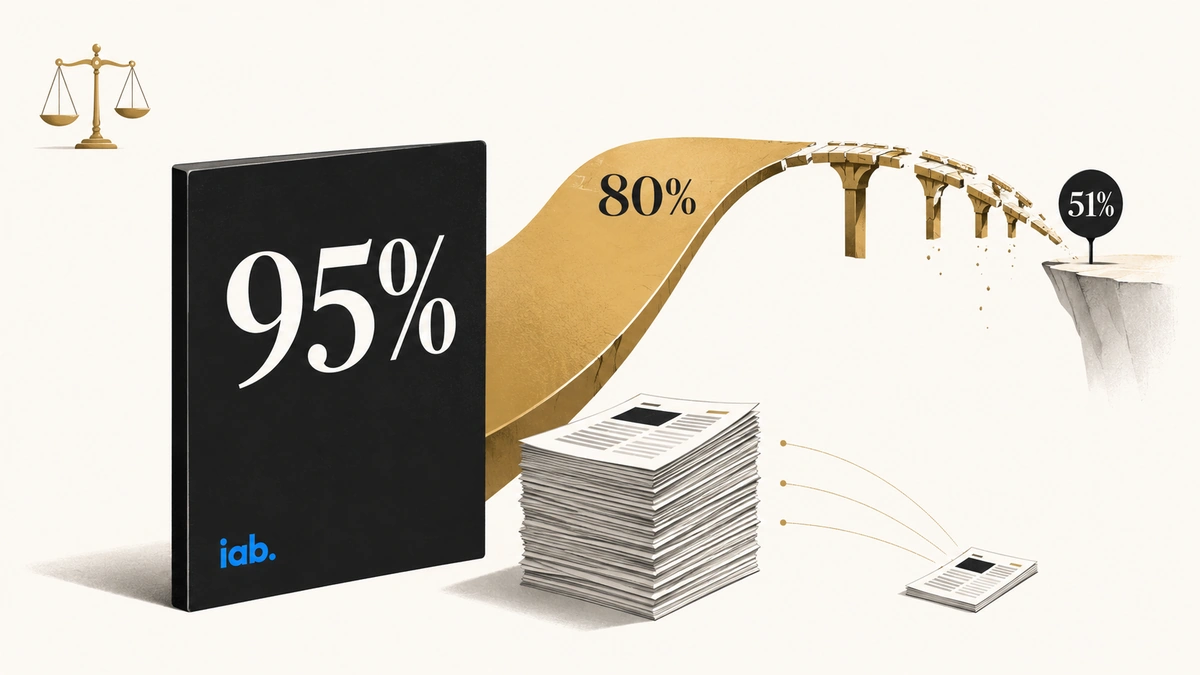
IAB found that 95% of publishers feel a moderate or significant effect from LLM-driven content discovery, and 80% describe the net impact as positive. The optimism has a limit: only 51% expect LLMs to become an important long-term source of value. Fair licensing, measurable referrals, attribution, and stronger content controls will decide whether early gains last.
IAB released two AI adoption studies on July 16, 2026, finding that 95% of publishers say LLM-driven content discovery is already having a moderate or significant effect on their organizations.
The headline sounds optimistic because 80% describe the net impact as positive. The forward-looking number is less comfortable: only 51% believe LLMs will become an important source of value, while 41% see them as a persistent discovery challenge. That challenge rises to 56% among news and financial publishers.
For B2B marketing teams, the important part is the distance between impact and durable value. Companies depend on publisher research, trade coverage, reviews, and owned content to shape AI answers. If those sources cannot measure or control reuse, marketers inherit a less reliable discovery layer.
Key Takeaways
- IAB says 95% of publishers feel a moderate or significant effect from LLM-driven discovery.
- Eighty percent call the net impact positive, but only 51% expect important long-term value.
- Fifty-one percent have signed at least one AI or LLM licensing agreement, and 35% are negotiating.
- Large publishers are three times as likely as small independents to have signed agreements, 60% versus 20%.
- Publishers want referral traffic, downstream measurement, revenue sharing, attribution, and access controls.
What the IAB AI Discovery Shift Found
The findings come from 110 U.S. publishers with at least $100,000 in annual revenue and 500 U.S. adults who had recently used AI tools. Both surveys ran in April 2026 through the IAB Insights Engine platform.
The IAB research package connects the two sides of the market. Among active AI users, 72% use the tools at least weekly and 40% use them daily. Yet 57% often or always verify AI answers, and 83% want clearer explanations of how those answers were generated.
That trust condition matters to publishers because a citation and a visible brand outcome are not the same thing. In our earlier reporting, 61.7% of AI citations were ghost citations, where a source link appeared without the publisher or brand being named in the answer. IAB’s study adds the commercial side: publishers want downstream value to be measured, not assumed from a crawl or citation count.
Why 80% Optimism Falls to 51% Future Value
The gap between 80% and 51% is the story. Publishers like the early outcomes but do not trust the exchange behind them. They create material that AI systems summarize, while referral traffic and attribution can disappear before value reaches the source.
That is why the top publisher requests are not limited to cash. They want traffic back to their properties, a way to measure downstream influence, revenue-sharing agreements, transparent attribution, and control over how content is accessed and summarized. Bluesky’s outcome-linked monetization direction offers one concrete response: the network would earn only when referred traffic creates incremental subscriptions or commerce, although no product terms have been announced.
When we covered Perplexity’s falling share of AI referral traffic, the lesson was that growing AI usage does not guarantee growing visits for every source or platform. IAB now shows publishers responding to the same split. Discovery influence can rise while the traffic and revenue needed to fund the source remain uncertain.
For B2B marketers, this changes source strategy. A citation dashboard should track whether a brand was named, whether a source link was shown, whether a visit followed, and whether that visit created a qualified action. One blended visibility score hides the exact value gap publishers are asking the market to solve.
Licensing Grows While Independent Publishers Fall Behind
The licensing figures are moving faster than the broader debate suggests. IAB says 51% of publishers have already signed one or more AI or LLM licensing agreements, while another 35% are in active negotiations. Among large publishers, 60% have signed. Among small independent publishers, the figure is 20%.
The capability gap appears in results too. Forty percent of independent publishers report no meaningful outcome from their AI strategies. Large media companies have legal teams, licensing power, audience data, and technical controls. Smaller publishers are more likely to negotiate from a weaker position or lack the instrumentation needed to prove contribution.
The IAB Tech Lab’s Content Monetization Protocols initiative is an attempt to build technical plumbing for licensed access. CoMP can communicate whether an AI system has permission and what content it wants to use. It does not set prices, create a marketplace, or block bots by itself.
That boundary matches Cloudflare’s move toward explicit AI crawler policies. Access control, commercial terms, and measurement are separate jobs. Publishers need all three, and a licensing agreement without reliable attribution still leaves the downstream value unclear. Apple’s latest documentation adds a concrete example: its AI-training opt-out is explicitly outside Search ranking, so the permission decision can be governed separately from discovery.
What B2B Publishers and Marketers Should Do Now
The practical response is to treat AI discovery as a measured distribution channel, not a free extension of search.
- Separate access decisions: Document which pages can support retrieval, which can support training, and which research or customer material should remain restricted.
- Track source outcomes: Measure citations, visible mentions, referral visits, assisted conversions, newsletter sign-ups, and qualified pipeline separately.
- Strengthen owned audiences: Give high-intent readers a reason to subscribe, register, or return directly instead of depending on an AI answer to send the next visit.
- Define licensing evidence: Require access logs, usage reporting, attribution rules, and a review process before treating a commercial agreement as successful.
- Audit tool claims: Compare how AI SEO and GEO platforms measure citations, mentions, sentiment, and traffic before buying a single visibility score.
Our read: the 95% figure proves that the discovery shift is already operating. The 51% figure proves that its business model is not settled. Publishers that can connect content access to attribution, direct audience growth, and commercial terms will have bargaining power. Everyone else risks becoming an invisible input to someone else’s answer. Australia’s News Bargaining Incentive design adds a policy route for one part of that exchange by rewarding publisher agreements, while leaving AI-generated use of news to a separate copyright process.
Frequently Asked Questions
The AI Discovery Shift is IAB’s 2026 study of how publishers are responding to LLM-driven content discovery. It measures current impact, sentiment, licensing activity, desired value exchange, content controls, and the different results reported by large, news, financial, and independent publishers.
IAB says 95% of surveyed publishers report a moderate or significant effect from LLM-driven content discovery. Eighty percent describe the net effect as positive, but only 51% expect LLMs to become an important source of value over the longer term.
Yes. Fifty-one percent of publishers in the IAB study have signed at least one AI or LLM licensing agreement, and another 35% are negotiating. The market is uneven: 60% of large publishers have signed, compared with 20% of small independents.
Start by separating AI access policies by content type, then track citations, visible mentions, referrals, and qualified actions as different outcomes. Build direct audience capture into high-value content and require usage reporting, attribution rules, and access logs in any licensing discussion.