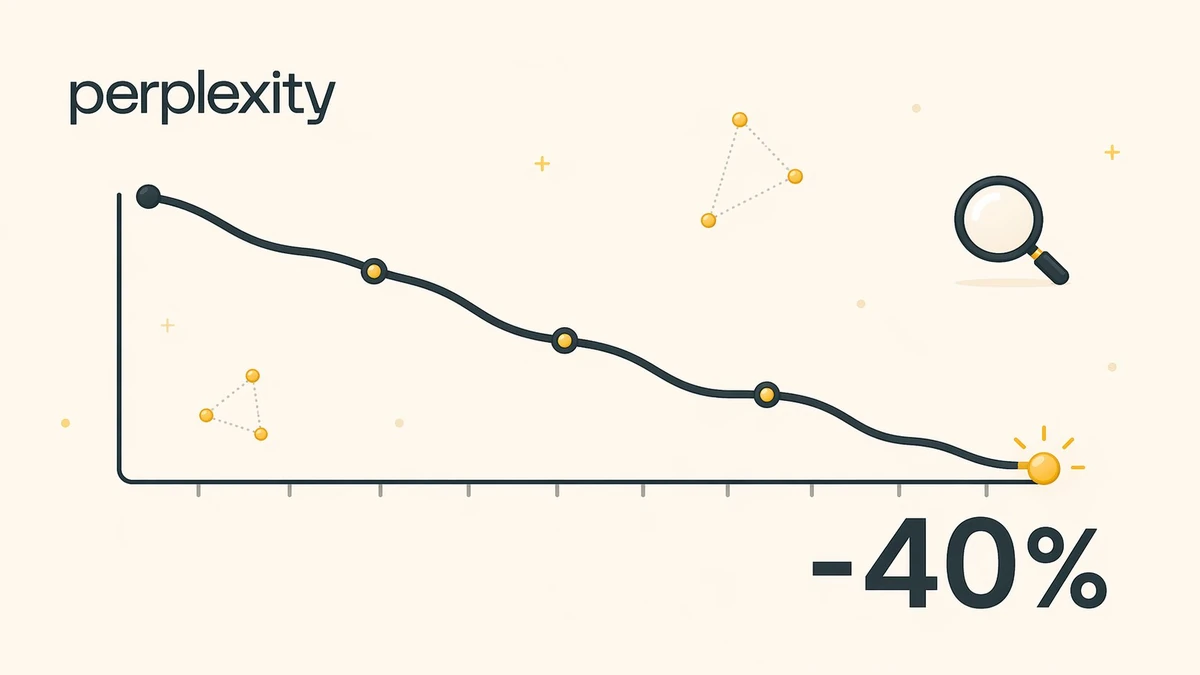
Perplexity’s share of AI chatbot referrals fell from 12.07% in April 2025 to 7.07% in March 2026. Gemini passed it for the number-two spot. That is a 40%+ drop in one year, and it happened while the company was growing users, revenue, and — on April 15 — publicly reinforcing its permanent no-ads stance through CCO Jesse Dwyer.
The two facts look contradictory. A company losing AI referral share doubling down on subscription-only monetization reads like a company ignoring the data. It is not. Perplexity is making a deliberate trade: volume for precision, mass market for high-intent. For B2B marketers, the question is not whether Perplexity keeps growing. It is whether the audience Perplexity holds onto is the one you need to reach. IAB’s publisher optimism and value gap shows the same split on the source side: influence can grow while referral and commercial confidence remain conditional.
Our read: for most mid-to-enterprise B2B ICPs, yes.
Key Takeaways
- Perplexity’s AI referral share fell from 12.07% in April 2025 to 7.07% in March 2026. Gemini overtook it as the #2 AI referral source.
- On April 15, CCO Jesse Dwyer reframed the monetization debate as volume vs. precision, arguing Perplexity is targeting “curiosity users” whose decisions are “GDP-altering or history-making.”
- Perplexity reports $200 million ARR and over 100 million users, with subscription tiers from $20 to $200 per month.
- 63% of US adults say ads in AI search results reduce their trust, per Ipsos data Perplexity is citing to justify the position.
- For B2B marketers, referral-share declines are the wrong metric. The metric that matters is whether your ICP is in the remaining user base, and for most mid-to-enterprise B2B, it is.
What the Decline Actually Means
The 40%+ drop is real, but the cause is not Perplexity getting worse. It is competitors catching up. When Perplexity launched, live source citation with multi-source synthesis was a genuine differentiator. Now Gemini, ChatGPT, Copilot, and Claude all cite sources in some form. The moat narrowed, the traffic redistributed.
What did not change is what Perplexity is optimized for: deeper research queries, executive-level decisions, analytical rigor, accuracy over speed. The user who uses Perplexity in 2026 is choosing it for the product, not the monopoly on citations. That product is now a legal target: CNN’s May 28 copyright suit over Perplexity’s Comet and answer engine alleges 17,000-plus works were copied to build it, putting the content pipeline behind those research answers under direct pressure.
The “Curiosity User” Framing Holds Up
Dwyer’s April 15 framing calls this user segment “curiosity users.” The operational definition is concrete: professionals whose decisions carry material consequences. CEOs evaluating acquisitions, finance leaders allocating capital, senior researchers validating claims. These users run fewer, deeper, higher-value queries where accuracy beats convenience.
The economics work if Perplexity holds that audience. A $200/month Max subscriber contributes as much ARR as roughly 1,200 ad impressions at typical CPMs, and Perplexity’s $200M ARR with 5x year-over-year growth suggests the math is holding up. Ipsos data also shows 63% of US adults say ads in AI search results reduce their trust in those results, which is the product argument Perplexity is leaning on. Both the ad-supported and subscription-only bets will be tested as ChatGPT’s ad rollout scales and Google AI Mode ads expand across the index. OpenAI’s May 5 maturation of the ChatGPT Ads Manager, with all-US self-serve, pixel tracking, and a Conversions API, sharpens the test on the ad-supported side: paid B2B reach inside ChatGPT now has Google-comparable attribution, while Perplexity’s ad-free wager doubles down on the curiosity-user audience the new attribution layer cannot reach.
Why This Matters for B2B Visibility Strategy
Here is the question that matters if you run B2B demand gen or RevOps: if Perplexity holds the executive-research audience in an ad-free system, what does that do to your AI visibility strategy?
It splits it into two tracks.
Track 1: ad-supported platforms (ChatGPT, Google AI Mode, Copilot). These will accept paid placement. Strategy here includes bidding, creative, and landing-page optimization, like any paid channel. You buy your way in.
Track 2: subscription-only platforms (Perplexity, Claude in most cases). The only way to be visible is to earn organic citations through content the platforms’ retrieval systems decide to cite. You cannot buy your way in. That is a content investment, not a media buy. Bluesky is now sketching a third path: outcome-linked revenue from referred subscriptions or commerce, without selling feed placement or relying only on audience subscriptions.
The split matters because the high-intent audience is disproportionately on Track 2. AI search traffic converts at 14.2% versus 2.8% for Google organic, and the conversion premium is concentrated in platforms that charge users instead of advertisers. If your ICP is senior decision-makers in mid-to-enterprise B2B, they are over-indexed on Perplexity’s remaining 33 million monthly active users.
What B2B Teams Should Actually Do
Three moves if you are planning AI visibility work this quarter:
Stop treating Perplexity’s declining share as a reason to deprioritize it. Referral share is a volume metric. For B2B, citation presence in high-intent research queries is what matters, and Perplexity still punches above its weight there. Gemini growing faster does not mean your ICP is using Gemini more for vendor research. Ghost citations explain why citation-based visibility reporting overstates real brand exposure: 61.7% of AI citations never name the brand in the answer text the user actually reads.
Get cited, not just indexed. Perplexity’s live crawler favors fresh, structured content with clear H2/H3 hierarchies and named authorship. Keeping dateModified current and tightening section structure improves Perplexity citation rates measurably faster than equivalent changes move Google rankings. This is what strong B2B SEO already looks like, with a cleaner feedback loop.
Plan for platform divergence. The split between ad-supported and subscription-only AI is not collapsing back. The only way to be visible across both models is to earn organic citations, which is why standalone AEO tools and HubSpot’s newly launched native AEO product are getting disproportionate attention this quarter. The strategic split 5W’s data reinforces goes further: the overlap between Google’s top 10 and AI-cited URLs has dropped from roughly 70% to under 20% in 24 months, which means the organic-citation work powering Track 2 visibility is no longer downstream of the SEO investment that funds Track 1. The free-tier baseline keeps expanding too: Clutch’s free AI Visibility Dashboard now gives every listed B2B agency the same four-engine citation read that paid tools sell for $499 to $699 per month.
Frequently Asked Questions
In referral share, yes. Perplexity dropped from 12.07% in April 2025 to 7.07% in March 2026, with Gemini overtaking it for the #2 spot. In revenue and subscriber base, no. Perplexity reports approximately $200 million ARR and over 100 million users in early 2026, with 5x year-over-year revenue growth. The decline is in traffic-volume share, not in business fundamentals or in the specific user segments Perplexity is optimizing for.
No. As of April 15, 2026, Perplexity has confirmed it has no plans to return to advertising. CCO Jesse Dwyer publicly reinforced the stance in a statement to Benzinga, reframing the monetization debate as volume vs. precision and arguing Perplexity targets high-intent users who value accuracy over ad-supported convenience. The company phased out its earlier ad experiment in late 2025.
Yes. Referral share declines are not the right metric for B2B. What matters is whether your ICP is in the remaining Perplexity user base. For mid-to-enterprise B2B targeting senior decision-makers doing research-heavy evaluation, Perplexity remains disproportionately concentrated in the buyer segments you want to reach. AI search traffic converts at roughly 14.2% versus 2.8% for Google organic, and the conversion premium is higher on subscription platforms like Perplexity that users actively choose.
Perplexity is subscription-only and will stay ad-free, so visibility is earned through organic citation, not paid placement. ChatGPT is adding ad placements and will eventually support both paid and earned visibility paths. For B2B marketers, that means Perplexity strategy is a content-and-authority investment with no media-buy component, while ChatGPT strategy will need both organic AEO work and paid ad strategy running in parallel. The paid side will matter more as ChatGPT Ads going CPC gives marketers a second route into AI-search visibility.