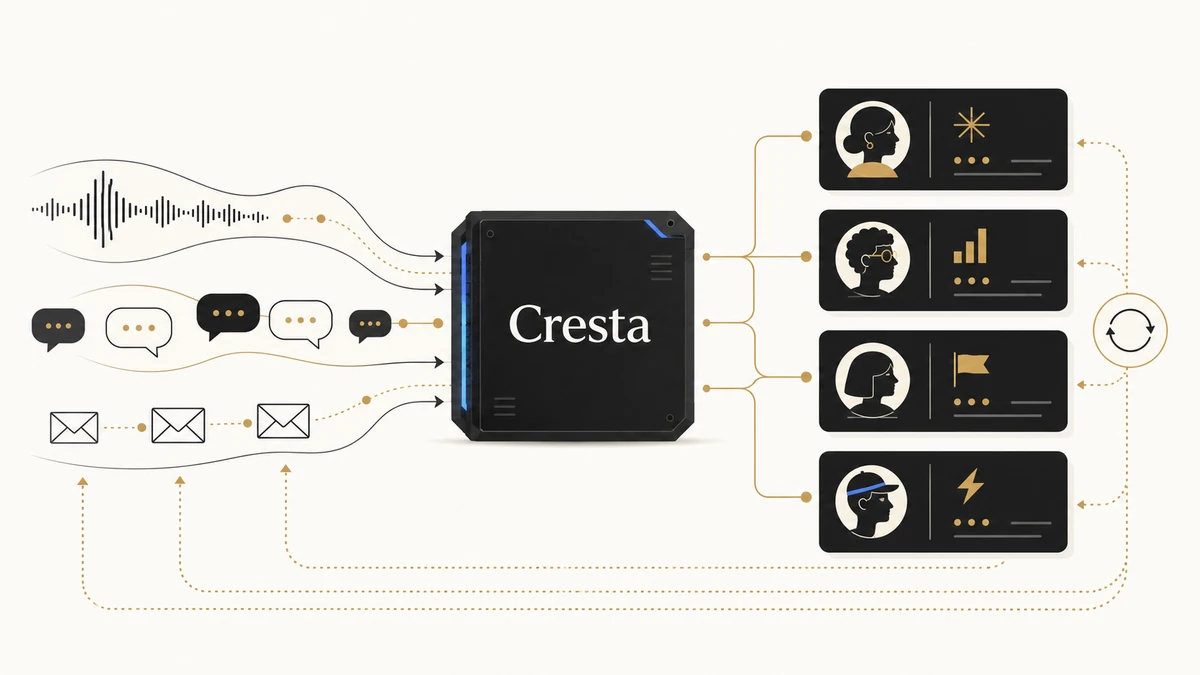
Cresta launched Synthetic Customers on May 28, a capability that turns a company’s real customer conversations into AI-generated personas for testing, training, and decision support. In the company announcement, Cresta says the personas are grounded in calls, chats, and emails from the business itself rather than demographic assumptions or a one-time research deck.
The product is designed for simulated conversations. Teams can use Synthetic Customers to test AI agents before deployment, train human agents against realistic scenarios, and pressure-test operational decisions. Cresta says each persona is traceable back to the real conversations that shaped it, and the company uses blind evaluations to test whether generated behavior is distinguishable from real customer behavior.
When we covered DocuSign Iris and its July agent rollout, the practical question was which workflow to pilot first. Cresta adds a step before the pilot reaches customers. Our read: synthetic personas are useful when they behave like regression tests for a customer-facing AI agent, not when they become another polished slide in the strategy deck.
Key Takeaways
- Cresta announced Synthetic Customers on May 28, 2026.
- The product generates AI personas from a company’s real calls, chats, and emails.
- Teams can use the personas to test AI agents, train human agents, and pressure-test decisions before launch.
- The B2B value is not persona generation by itself. It is repeatable testing against the behavior already visible in customer conversations.
What Cresta Synthetic Customers Actually Does
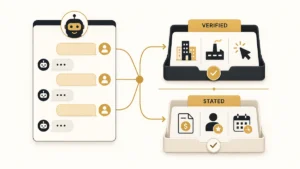
Traditional personas summarize a segment: company size, role, pain points, and a few interview quotes. Cresta’s model is more operational. The system analyzes conversation data and creates representative personas that can participate in simulated interactions. Each persona can respond to a new scenario, and its behavior is tied back to patterns found in the company’s own conversation history.
Cresta’s launch blog gives a worked example. A financial-services team analyzes 90 days of closed customer conversations and finds four customer profiles representing 100% of support volume. The personas are ranked by actual traffic volume, so a team can see which customer types matter most before deciding what to test or fix.
A short product overview video shows the same product logic: generate realistic personas from real conversation data, then use them as prompts inside simulated visitor tests. The claim worth evaluating is not whether the persona sounds polished. It is whether it exposes failure cases before a customer-facing workflow ships.
Why This Matters for B2B AI Agent Testing
Customer-facing AI agents fail in ways a happy-path demo rarely catches. A buyer asks an ambiguous question. An account has two products with different contract terms. A customer mixes billing, technical, and renewal issues in one message. A synthetic persona grounded in actual conversation patterns can make those cases repeatable.
That matters because the surrounding stack is not equally ready for autonomous use. SaaStr’s 144-API report card showed how agent-readiness depends on the systems an agent must call. A simulation layer adds the customer-behavior side of the test. The agent needs access to the right data, and it needs to respond correctly when the conversation takes an unexpected turn.
The same discipline belongs in a RevOps AI agent rollout. Start with a supervised workflow, measure accuracy and coverage, and move only routine actions toward autonomy. Synthetic Customers gives contact-center teams a way to create repeatable test scenarios from live customer evidence before the workflow reaches production.
The Hidden Catch: Real Conversations Are Not Automatic Truth
Grounding a persona in real conversations is stronger than guessing. It is not a substitute for judgment. The dataset can still overrepresent the loudest customers, recent incidents, a seasonal spike, or one support channel. A model trained on support conversations may also be weak at sales objections or renewal risk if those interactions sit somewhere else.
B2B teams should ask four questions before trusting the output: which channels were included, what time window was used, how personas are updated, and how edge cases are reviewed by humans. If the answers are vague, the persona may look realistic while missing the customer segment that matters most.
CRM quality matters too. Our CRM software examples guide separates software choice from the broader CRM system: integrations, custom fields, automation rules, and permissions. Synthetic personas become more useful when conversation data and CRM context are connected cleanly enough to explain why a behavior occurred.
The 30-Day Synthetic-Customer Pilot
- Pick one bounded workflow. Start with a high-volume service issue, onboarding question, or renewal handoff. Avoid a broad “test the entire customer journey” brief.
- Review the persona mix. Compare the generated profiles against known segment, channel, and account-tier distributions. Look for missing enterprise accounts, seasonal spikes, and overrepresented complaint patterns.
- Create a regression set. Save 20-30 scenarios that expose common errors and edge cases. Rerun the same set after each prompt, policy, or model update.
- Score the handoff, not just the answer. Measure whether the agent escalates correctly, preserves context, and routes the conversation to the right human when confidence drops.
- Expand only after the error rate stabilizes. A realistic persona library earns its keep when it prevents a production mistake, not when it generates more test volume.
Frequently Asked Questions
Cresta Synthetic Customers are AI-generated customer personas grounded in a company’s real conversation data, including calls, chats, and emails. Teams can use them inside simulated conversations to test AI agents, train human agents, and review customer-impact decisions before deployment.
Traditional personas usually summarize research into a static profile. Cresta’s personas are generated from conversation patterns and can participate in simulations. The useful difference is behavioral testing: a team can rerun scenarios and observe whether an AI agent handles representative customer behavior correctly.
Start with a bounded workflow and score answer accuracy, escalation quality, context preservation, and routing. Build a saved regression set with common requests and edge cases. Review the persona mix for missing segments and expand only after the error rate stabilizes.