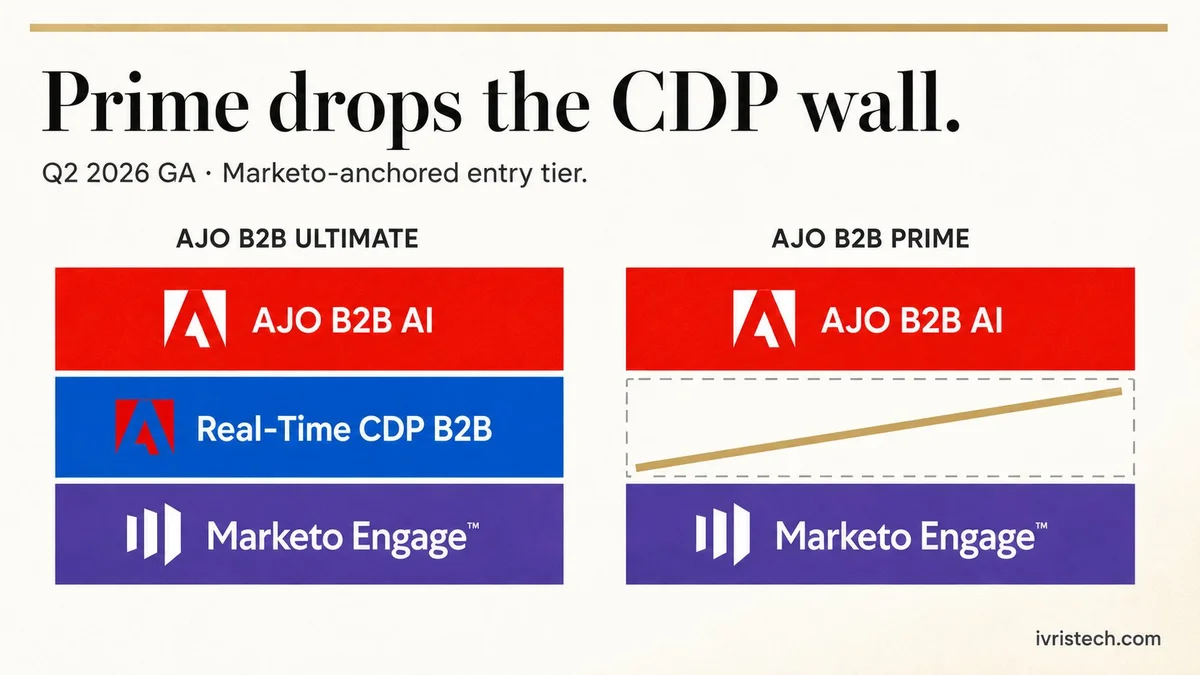
At Adobe Summit 2026 on April 20, Adobe announced AJO B2B Edition Prime, a Marketo-powered entry tier of Adobe Journey Optimizer B2B that drops the Real-Time CDP B2B requirement gating the existing edition. The existing edition has been renamed AJO B2B Edition Ultimate. Prime ships generally available in Q2 2026.
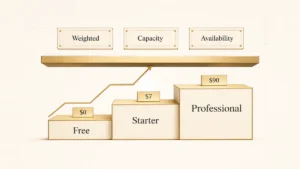
The launch reorganises Adobe’s B2B line into a three-step ladder: Marketo Engage at the foundation, Prime running AI orchestration on Marketo data alone, and Ultimate adding Real-Time CDP B2B for multi-source orchestration. Both tiers include Semantic AI Decisioning, the Sales Qualifier agent, and buying group orchestration. The change cuts the 6-to-12-month CDP migration that previously gated mid-market access.
For B2B marketing teams, the operational read is procurement timing. Marketo customers can sign Prime in Q2 without a parallel CDP commitment, which reframes the next vendor evaluation against HubSpot or Salesforce. The conversation shifts from “should we replace our martech architecture” to “should we consolidate on the platform we already run.”
Key Takeaways
- Adobe AJO B2B Edition Prime ships GA in Q2 2026 as a Marketo-powered entry tier — no Real-Time CDP B2B prerequisite required.
- The existing AJO B2B Edition is renamed Ultimate. Three-tier ladder now: Marketo Engage → AJO B2B Prime → AJO B2B Ultimate.
- Both Prime and Ultimate include Semantic AI Decisioning, the Sales Qualifier agent, and buying group orchestration.
- Removing the RT-CDP floor cuts a 6-12 month CDP migration that priced mid-market out.
- Procurement implication: Marketo customers gain a Q2 entry path before evaluating HubSpot or Salesforce architecture replacements.
What Adobe Actually Announced
AJO B2B Edition Prime is a packaging change with a real architectural concession behind it. MartechNotes confirmed the tier runs entirely on Marketo Engage data, where the previous AJO B2B Edition required Real-Time CDP B2B as the underlying data fabric. Prime keeps the AI features but removes the CDP dependency.
Both editions ship the same agent surface. Semantic AI Decisioning analyses engagement signals to recommend the next best journey step. The Sales Qualifier agent runs AI-first business development against the buying committee. Buying group orchestration coordinates messaging across the full purchasing committee. The functional gap between Prime and Ultimate is the data layer, not the AI layer.
Adobe positioned Prime in the same Summit announcement that retired the Experience Cloud name and rebranded the platform as Adobe CX Enterprise. The Prime tier is the B2B-mid-market piece of that broader repositioning, not a separate launch. Pricing has not been disclosed.
Why Removing the RT-CDP Floor Matters
The Real-Time CDP B2B prerequisite was the deal-breaker for mid-market Marketo customers evaluating AJO B2B over the last 18 months. CDP migrations are the unglamorous part of the Adobe stack: schema work, integration, identity resolution, plus 6 to 12 months before the CDP returns enough data to feed the orchestration layer above. The CDP-first sequence priced mid-market teams out before they reached the AI features they wanted. Databricks CustomerLake’s agentic CDP now pushes the opposite argument: keep the CDP inside the governed data platform and let agents act on it directly.
Prime inverts the sequence. Marketo customers adopt the AI layer first, then upgrade to Ultimate when their data maturity justifies the CDP. Adobe’s roadmap notes describe Prime as the ladder’s middle rung, not a permanent stop.
Our read: Prime is less a new product than a refinanced one. Adobe is conceding that CDP-first pricing kept mid-market growth slower than it should have been. The retrofit is to let customers in earlier and grow them up the ladder — the same revenue motion HubSpot and Salesforce have used for years on their lower tiers.
How Prime Repositions Adobe Against HubSpot and Salesforce
The mid-market B2B AI orchestration market has three distinct vendor bets going into Q2 2026. HubSpot is betting on outcome-based pricing — $0.50 per resolved Customer Agent conversation, $1 per acted-on Prospecting Agent lead — with the operational layer extended further by the rebuilt Prospecting Agent that pulls from Apollo and ZoomInfo seats. Salesforce is betting on consumption pricing across the Headless 360 architecture with agent-fabric governance. Adobe’s bet, in Prime, is on capability-tier laddering against an installed Marketo base. That base carries a structural risk: SaaStr’s report card scored Marketo a 50 (C) for agent-readiness, the lowest of the marketing platforms graded, which limits how far Prime’s AI layer can run unattended on Marketo data.
Each bet fits a different buyer profile. Outcome-based pricing fits teams with predictable per-result economics. Consumption pricing fits teams with mature finance ops and a developer bench. Tier laddering fits teams that already run Marketo, want AI without re-architecting data, and prefer Adobe’s ABM heritage.
HubSpot’s Spring 2026 Spotlight shipped on April 14, six days before Adobe Summit. The proximity matters because mid-market vendor evaluations now have three credible 2026-vintage options on the table at once, where last year only HubSpot and Salesforce were realistic for teams under enterprise CDP scale.
What B2B Marketing Teams Should Decide Before Q2
Three decisions if Marketo is in your stack and you have been on the AJO B2B fence.
First, model Prime versus Ultimate against your data maturity. If your Marketo instance has clean lead and account data and reporting sits inside a single MAP, Prime is enough. If you run multiple data sources and need them stitched, you still need Ultimate.
Second, audit Marketo data hygiene before Prime goes live. Sales Qualifier and buying group orchestration both pull from Marketo segments. Stale lifecycle stages, broken program logic, and orphaned leads route the AI to the wrong people. Prime amplifies the underlying data, it does not fix it.
Third, line up your competitive evaluation calendar. When Prime pricing lands, expect a two-to-four-week window to compare against HubSpot’s outcome-based AI and Salesforce’s consumption-based Agentforce. Decide which buyer profile you are before pricing arrives, not after.
The wider context: Adobe’s installed Marketo base is the bet. Prime is a defensive packaging move that keeps mid-market customers inside the Adobe ladder rather than migrating when their AI needs outgrow Marketo Engage. Whether the bet holds depends on Prime’s pricing relative to HubSpot’s per-result ceiling and Salesforce’s consumption floor.
Frequently Asked Questions
Adobe announced Prime at Adobe Summit 2026 on April 20 with general availability in Q2 2026. The existing AJO B2B Edition was renamed Ultimate as part of the same announcement. Prime is a Marketo-powered entry tier; Ultimate retains the Real-Time CDP B2B foundation. Pricing has not been disclosed publicly.
Both editions include Semantic AI Decisioning, the Sales Qualifier agent, and buying group orchestration. The difference is the data layer. Prime runs entirely on Marketo Engage data. Ultimate adds Real-Time CDP B2B for multi-source orchestration. Prime is positioned as the mid-market entry tier; Ultimate as the full enterprise platform.
The CDP prerequisite gated mid-market access. CDP migrations take 6 to 12 months and require schema, identity, and integration work before the orchestration layer above it returns value. Prime lets Marketo customers adopt AI orchestration first and add the CDP later, opening the AJO B2B ladder to teams that previously could not afford the full architecture.
Run all three evaluations in parallel. Prime, HubSpot’s outcome-based Breeze agents, and Salesforce’s consumption-based Agentforce all target overlapping mid-market budgets but with different commercial models. Decide which buyer profile fits your team (predictable per-result, consumption, or tier-laddered) before Prime pricing lands so the comparison is structural, not reactive.