Salesforce’s September 14 APAC Agentforce release, following the global launch on September 11, introduces a new long-horizon runtime that lets an AI agent keep pursuing a goal across days and weeks instead of stopping after one task. Hunter, its outbound sales agent, is the first agent on that runtime and is in pilot now, with general availability planned for November 2026.
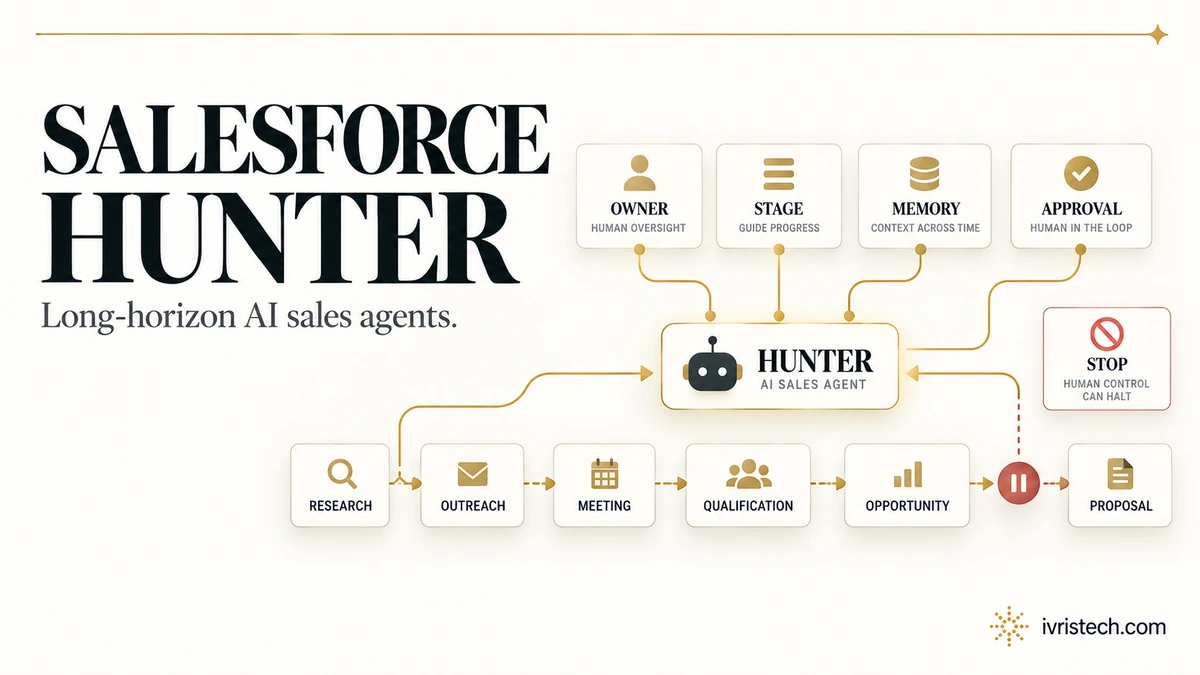
This is more than persistent chat memory. Salesforce says Hunter can research prospects, send outreach, progress opportunities, prepare proposals, and support pipeline reviews and forecasts. Its plan persists through memory, durable execution, and dynamic steering as new information arrives.
For RevOps, that changes the control problem. A permission that made sense when an agent began working an opportunity may no longer make sense two weeks later, after ownership changes, a buyer replies, qualification changes, a rep takes over, or another agent acts. The operating question is no longer only what an AI agent may do. It is how long that authority should remain valid.
Direct answer — what does Salesforce Hunter change for RevOps?
Hunter turns sales-agent authority into a persistent state problem. Salesforce says the agent can keep a goal, plan, customer context, and approved actions moving across weeks. RevOps therefore needs controls that expire or change when the underlying deal changes: ownership, stage, buyer intent, human activity, approval status, outreach cadence, and the point at which the agent must stop or hand control back.
Key Takeaways
- Hunter is the first Agentforce agent on Salesforce’s new long-horizon runtime; it is in pilot with GA planned for November 2026.
- The runtime combines memory across sessions, durable execution, and dynamic steering so work can continue as circumstances change.
- Salesforce says Hunter can progress opportunities, prepare proposals, and support pipeline and forecasting work, not just prospect and send outreach.
- Piper is GA now for inbound pipeline generation, but Salesforce does not say Piper is on the long-horizon runtime; Hunter is explicitly the first.
- The RevOps requirement is time-aware control: write rights, approvals, cadence, handoffs, attribution, and stop rules must remain valid as a deal changes.
What Salesforce Actually Changed
Salesforce describes Hunter as a long-running sales agent rather than disconnected automations. On its Hunter product page, the company says the agent can turn a revenue goal into a plan, carry out approved actions, track progress, and adjust as buyers and priorities change. Its memory is attached to accounts, contacts, and opportunities rather than one chat window.
The release gives a concrete example: a seller can ask Hunter to rescue at-risk deals before quarter-end. Hunter can build a plan and operate within guardrails that decide when it can act autonomously and when seller approval is required. Salesforce says customer-facing actions such as outreach or a proposal can require rep approval and that Hunter’s actions are logged.
Piper sits on the inbound side. Salesforce says it works across websites and inboxes to engage, qualify, and convert leads into pipeline, and Piper is GA now. But the release is precise: Hunter is the first agent on the long-horizon runtime. Calling Piper long-horizon today would go beyond Salesforce’s documentation.
The Control Problem Is Authority That Outlives Context
When IVRIS covered Salesforce in Claude’s 37 sales skills, the governance question was capability-level: which skills should read, recommend, or write to CRM. Hunter adds a second dimension: time. The same permission can produce a different risk after the record, buyer, or human owner has changed.
Consider an opportunity Hunter has worked for 18 days. The owner changes. A rep has a call that changes qualification. The opportunity moves stages. Marketing launches another sequence. Another agent creates a fresh action. Any of those events could make Hunter’s earlier plan stale.
Our read: a long-horizon sales agent needs authority that is conditional, not permanent. RevOps should be able to answer which state changes invalidate the current plan, which CRM writes require a new approval, how recent intent must be before it can drive outreach, and whose action wins when a human and an agent touch the same opportunity.
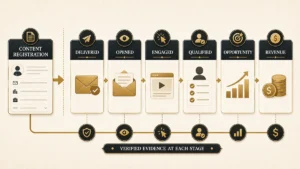
This also reaches measurement. If Piper qualifies a contact, a seller takes the meeting, Hunter later progresses the opportunity, and a manager changes the stage, pipeline credit cannot simply collapse into “AI-sourced” or “human-sourced.” Teams need actor, timestamp, prior state, resulting state, and approval path before attribution or productivity claims become decision-grade.
RevOps Needs Stop Rules Before Hunter Reaches GA
Salesforce provides business rules, permissions, approval settings, logged actions, and deterministic controls through Agent Script. The policy design still belongs to the customer. Before November, RevOps teams piloting Hunter should define five operating rules:
- Set object-level stop conditions. Decide which events pause or terminate autonomous work, such as an ownership change, disqualification, closed stage, buyer opt-out, seller takeover, or a booked meeting that changes the motion.
- Separate recommendation from write authority. A next-step suggestion is not the same risk as changing qualification, stage, close date, forecast inputs, or sending a proposal. Gate consequential writes separately.
- Add collision and cadence rules. Human activity, another agent’s action, or a fresh campaign should suppress duplicate outreach until the record is reconciled.
- Put a clock on memory and intent. Persistent context should preserve source and recency. Signals that were useful two weeks ago should not silently remain authoritative after newer evidence arrives.
- Define the handoff and evidence trail. Name the human owner, record when the agent took and released control, preserve approvals and state changes, and decide how mixed human-agent contribution will be reported.
Long-horizon execution makes an agent more useful because it does not forget the objective after one interaction. It also means governance cannot be a one-time permission granted at launch. The better control model is continuous: permission plus current state plus recency plus an explicit reason to keep acting.
Frequently Asked Questions
Salesforce says Hunter is in pilot now and plans general availability for November 2026. Hunter is the first Agentforce agent using the new long-horizon runtime. Salesforce says more agents will move onto that runtime over time, and customers will eventually be able to build long-horizon agents of their own.
Not according to Salesforce’s September announcement. Piper is generally available for inbound pipeline generation across websites and inboxes, but Salesforce explicitly says Hunter is the first agent running on the long-horizon runtime. Piper matters to handoffs and pipeline coordination, but calling it long-horizon would overstate the current documentation.
Salesforce defines the runtime around three capabilities: memory that preserves context and progress across sessions, durable execution that keeps a plan running and lets it resume or course-correct, and dynamic steering that adapts behavior from user feedback. The goal can therefore continue across days or weeks instead of ending with one interaction.
RevOps should define who owns each lead or opportunity, which fields Hunter may write, which actions need approval, how outreach frequency is coordinated, when remembered intent expires, what triggers a human handoff, how duplicate actions are suppressed, what evidence is logged, and which state changes force the agent to stop or re-plan.