X has launched an official Ads MCP server that lets MCP-compatible AI tools work directly with X advertising accounts. The first-party server exposes 23 tools for account reads, analytics, targeting searches, campaign management, and ad creation.
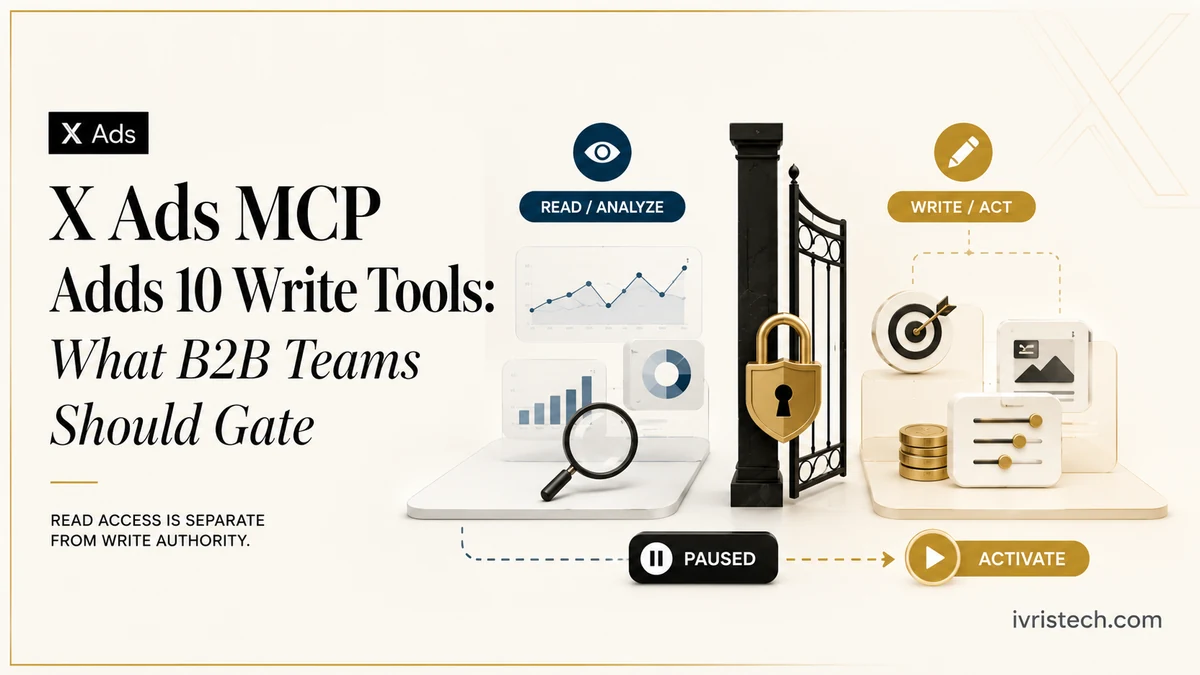
The important number is not 23. It is 10: X documents 10 write tools, including campaign and line-item creation and updates, targeting changes, promoted posts, and explicit activation actions. X also separates access into ads.read and ads.write OAuth scopes. New campaigns and line items are created paused by default.
For B2B paid-media teams, that creates a clearer line than the usual “AI assistant versus AI agent” debate. Read access lets an agent investigate performance. Write access gives it operational authority. And because activation is itself available inside the write toolset, “paused by default” should not be mistaken for a documented human-approval requirement.
Direct answer — what does X Ads MCP change for B2B paid-media teams?
X Ads MCP moves AI from campaign analysis into account actions. X exposes 23 ad tools, including 10 writes, while separating read access from write access through OAuth scopes. New campaigns and line items start paused, but the write scope also exposes activation tools. B2B teams therefore need their own approval boundary before granting agents live-account authority.
Key Takeaways
- X’s official Ads MCP exposes 23 tools through
ads-api.x.com/mcp. - Ten documented tools can write to an ad account, including campaign and line-item activation.
ads.readsupports read and analytics access;ads.writeenables campaign and creative writes.- New campaigns and line items start paused, but X’s public docs do not describe a mandatory human confirmation before every activation.
What X Actually Shipped
X Ads MCP is a remote Model Context Protocol server built into X’s Ads API gateway. An MCP-compatible client such as Grok, Claude Code, or a custom agent can discover the available tools and chain them from a natural-language request. The documented sequence can move from account discovery to funding instruments, campaign creation, line items, targeting, creatives, reporting, and activation.
It is also separate from X’s general MCP server at api.x.com/mcp. The general server works with X API functions such as posts, search, users, bookmarks, trends, news, and Articles. The advertising server sits at ads-api.x.com/mcp and exposes the Ads-specific toolset. Treating the two as one launch blurs the permissions that matter most to media teams.
The Ads permission model is simple but consequential. A team can omit ads.write and give an agent read-only access for campaign inspection and analytics. Granting ads.write opens the campaign and creative write tools. X does not document separate OAuth scopes for “create” and “activate.”
Why This Changes the B2B Paid-Media Control Model
When we covered TikTok Agentic Hub, the governance question was which advertising tasks an agent should be allowed to run. X makes that question more concrete because the native documentation exposes a visible read-versus-write permission boundary.
That is useful for lean B2B teams. An agent with read access can inspect campaign structure, summarize performance, check reach, and search targeting options without changing the account. The same conversation can become operational once write access is added. The friction shifts from clicking through Ads Manager to deciding which tool calls the agent is allowed to make.
Our read: the important launch is not natural-language campaign creation. It is the compression of analysis and execution into the same agent session. That can shorten routine paid-media work, but it also makes permission design part of campaign operations rather than an IT-only concern. Magnite’s Amnet France CTV campaign shows that same compression in a live buying workflow, while also making clear that faster setup did not eliminate trader strategy.
The Hidden Catch: Paused Is Not the Same as Approved
X has added a useful safety default: campaigns and line items created through Ads MCP start paused, so creation alone does not begin delivery. But the same documented write toolset includes activate_campaign and activate_line_item. The public documentation describes scopes and paused creation; it does not describe a mandatory human confirmation step before every native write or activation.
That distinction matters because some search results describe approval-gated X Ads workflows that belong to third-party connectors. Markifact, for example, says its own X Ads connector waits for approval before writes. That is a connector-level control. It should not be generalized into a claim that X’s first-party Ads MCP requires the same approval path.
For a B2B team, the safest interpretation is therefore permission-first: paused creation is a brake, not the whole governance system. If the agent has ads.write, your client, orchestration layer, or operating process should decide which live changes still require a person.
What B2B Paid-Media Teams Should Gate Now
Start with ads.read. Use the agent for account discovery, performance analysis, reach checks, and targeting research. Compare its output with the team’s normal review process before adding any write authority.
Separate the write test from everyday access. Use a dedicated X app or tightly scoped operating setup for experiments, and limit it to the ad accounts the operator actually needs. X says the user’s OAuth token bounds which accounts the agent can see.
Put approval around high-impact actions. Campaign activation, line-item activation, targeting changes, promoted-post creation, and other live-account writes deserve an explicit review rule. The broader copilot-to-autopilot model for marketing agents applies here: autonomy should expand only after the workflow proves accurate inside defined limits.
Log intent and execution separately. Keep a record of what the marketer asked, what the agent proposed, which tools it called, and what actually changed in the account. That turns a vague “AI did it” incident into an auditable campaign event.
X Ads MCP makes agent-run paid media more practical. For B2B teams, the next advantage will not come from giving an agent every tool on day one. It will come from knowing exactly where analysis ends and account authority begins.
Frequently Asked Questions
X Ads MCP is X’s official Model Context Protocol server for advertising workflows. It lets compatible AI clients discover tools for reading ad accounts, analyzing performance, searching targeting options, and creating or managing campaigns and creatives through X’s Ads API gateway.
No. X documents separate ads.read and ads.write scopes. A team can omit the write scope for a read-only agent, while granting ads.write enables campaign and creative write operations, including documented activation tools. Without ads.write, X says write tools fail with authorization errors.
New campaigns and line items created through X Ads MCP start paused, according to X’s documentation. They do not spend simply because they were created. However, the write toolset includes campaign and line-item activation, so teams should define their own approval rule before granting live write authority.
No. X’s general MCP server at api.x.com/mcp exposes broader X API functions such as posts, search, users, bookmarks, trends, news, and Articles. X Ads MCP is a separate advertising server at ads-api.x.com/mcp with ad-account tools and Ads-specific OAuth scopes.