Direct answer — What is the Salesforce Partner Program?
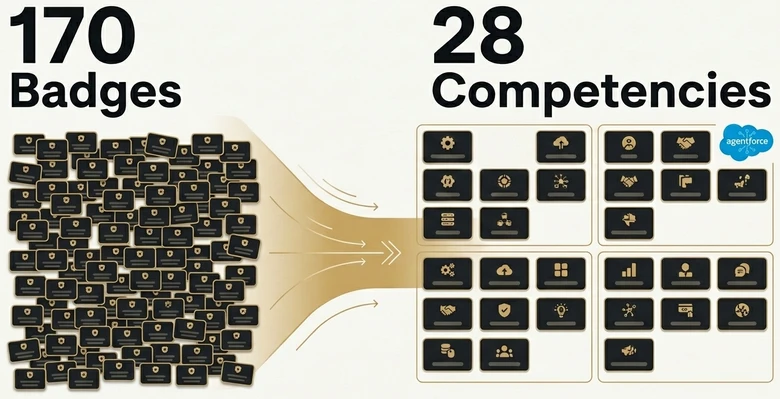
The Salesforce Partner Program certifies the consultancies that implement Salesforce. In March 2026 Salesforce overhauled it, collapsing the old four-tier consulting structure (Base, Ridge, Crest, Summit) into two tiers, Summit and Select, and cutting roughly 170 badges to 28 core competencies. Recognition now depends on project outcomes, CSAT scores, and certifications, with Summit status requiring demonstrated Agentforce deployment. The redesign concentrates on AI delivery, so non-AI partners risk losing relevance within about 12 months.
If your company relies on a Salesforce consulting partner, the firm you hired six months ago may not be qualified under Salesforce’s new rules. That’s not an exaggeration — it’s the direct consequence of the most aggressive partner program overhaul in Salesforce’s history.
In March 2026, Salesforce announced it’s collapsing its long-standing four-tier consulting partner structure into just two tiers: Summit and Select. The company also slashed partner credentials from roughly 170 badges to 28 core competencies. The message is clear: if your partner can’t deploy Agentforce, Salesforce’s autonomous AI agent platform, they’re getting left behind.
Key Takeaways
- Salesforce replaced its 4-tier partner hierarchy with 2 tiers (Summit and Select) in March 2026
- 170 partner badges cut to 28 competencies — an 84% reduction focused on AI delivery
- Summit Partner status now requires demonstrated Agentforce deployment experience
- Businesses should ask current Salesforce partners where they stand in the transition
What Actually Changed
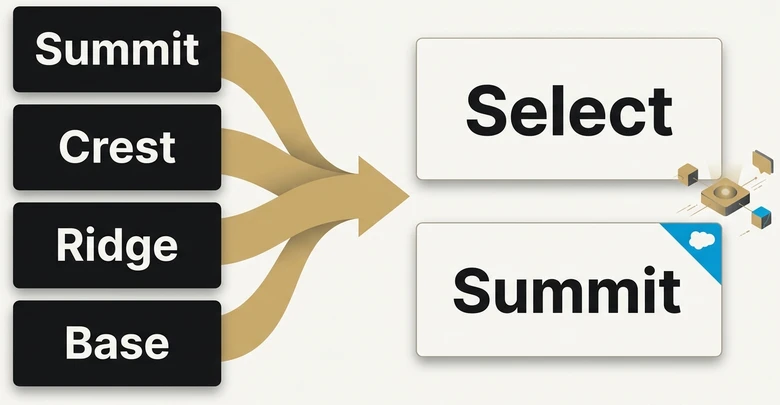
Salesforce’s old system — Base, Ridge, Crest, and Summit — ranked partners primarily on credentials, deal volume, and general certifications. A consultancy could reach Gold status by accumulating the right number of certified admins and architects without ever touching AI.
The new structure throws that out. Under the two-tier model, partner recognition is tied to project outcomes, customer satisfaction (CSAT) scores, and certifications within 28 focused areas. Those 28 competencies concentrate heavily on Agentforce deployment, Data Cloud proficiency, and industry-specific AI delivery. According to Salesforce SVP Nick Johnston, “Specialization is the new currency of the agentic era.”
The company is backing this with money. Salesforce is targeting $1 billion in revenue tied to partner incentives, covering lead generation, pre-sales, and post-sales implementation linked to customer adoption metrics. Partners now have to ship more than front-office Agentforce too: the Agentforce Operations SKU that shipped April 29 adds back-office workflow expertise to the competency requirements, and the implementation partner who deployed Sales Cloud three years ago may not be ready for it.
The urgency behind this restructuring is backed by data: Salesforce’s 2026 State of Sales report found 87% of sales teams now use AI and 54% have deployed agents. Salesforce needs its partner ecosystem to keep up.
Why This Matters for B2B Teams Using Salesforce
If you’re a mid-market B2B company running Salesforce — and about 21.8% of the CRM market does — this restructuring changes how you evaluate implementation partners.
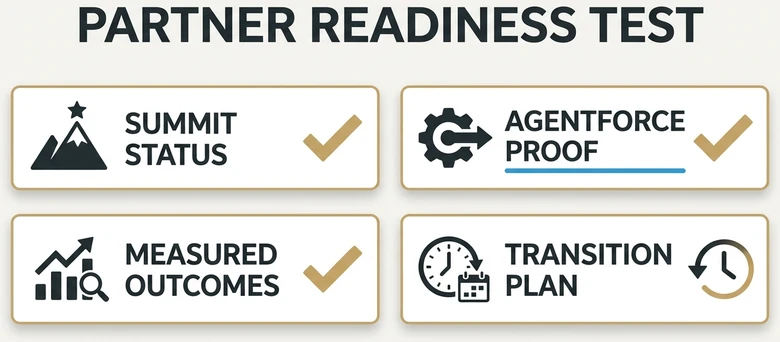
The partner who set up your Sales Cloud three years ago may now be scrambling to retool for Agentforce competency. Partners operating primarily on classic Sales Cloud and Service Cloud implementations have roughly 12 months to pivot before the old credentials become meaningless. That creates a quality gap during the transition.
Here’s the practical test: ask your current Salesforce partner two questions. First, what’s their Summit Partner application status? Second, can they demonstrate a live Agentforce deployment with measurable outcomes? A firm still presenting Gold or Platinum credentials in 2026 without mentioning the transition is likely not ahead of the curve.
PRO TIP
The updated AppExchange now surfaces partners based on verified industry results rather than company size. Use it to find “delivery-ready” experts with specific Agentforce competencies relevant to your industry.
HubSpot Is Making the Same Move
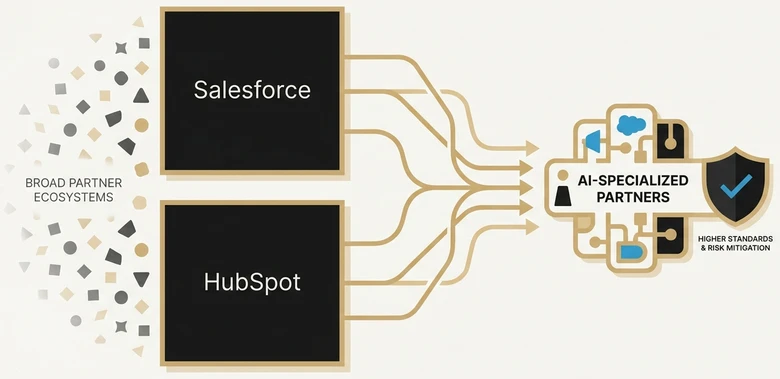
Salesforce isn’t alone here. HubSpot simultaneously restructured its own partner program around its Breeze AI platform. HubSpot’s shift to outcome-based pricing — $0.50 per resolved conversation, $1 per qualified lead — signals the same direction: both companies are shrinking their partner pools and demanding deeper specialization. According to Canalys chief analyst Jay McBain, this reflects a broader industry shift away from large partner ecosystems toward smaller groups of deeply specialized firms.
The underlying driver is risk. Autonomous AI agents can produce incorrect outputs or execute workflows incorrectly — the hallucination problem. Poorly configured AI implementations don’t just underperform; they can actively damage customer relationships. Both Salesforce and HubSpot are using stricter partner requirements to mitigate that risk before it becomes a trust problem.
For B2B companies evaluating CRM platforms in 2026, the partner ecosystem quality is now as important as the platform features. A powerful AI agent platform means nothing if the consultancy deploying it can’t ensure the agents are accurate, compliant, and actually delivering results. If you’re comparing platforms, our HubSpot vs Salesforce comparison covers the full feature and pricing picture, and understanding how AI agents fit into your RevOps stack is essential context for this decision.
What to Do Now
Review your current Salesforce partner relationship against the new competency framework. If your partner is focused entirely on traditional implementation work with no AI capability roadmap, it’s time to start evaluating alternatives. The transition window is 12 months — don’t wait until your partner loses their accreditation to find out.
Read Next
- HubSpot vs Salesforce: which CRM is right for your B2B team
- ChatGPT ads are live: the new B2B discovery channel you can’t ignore
- Google AI Mode ads go live: how B2B paid search just changed