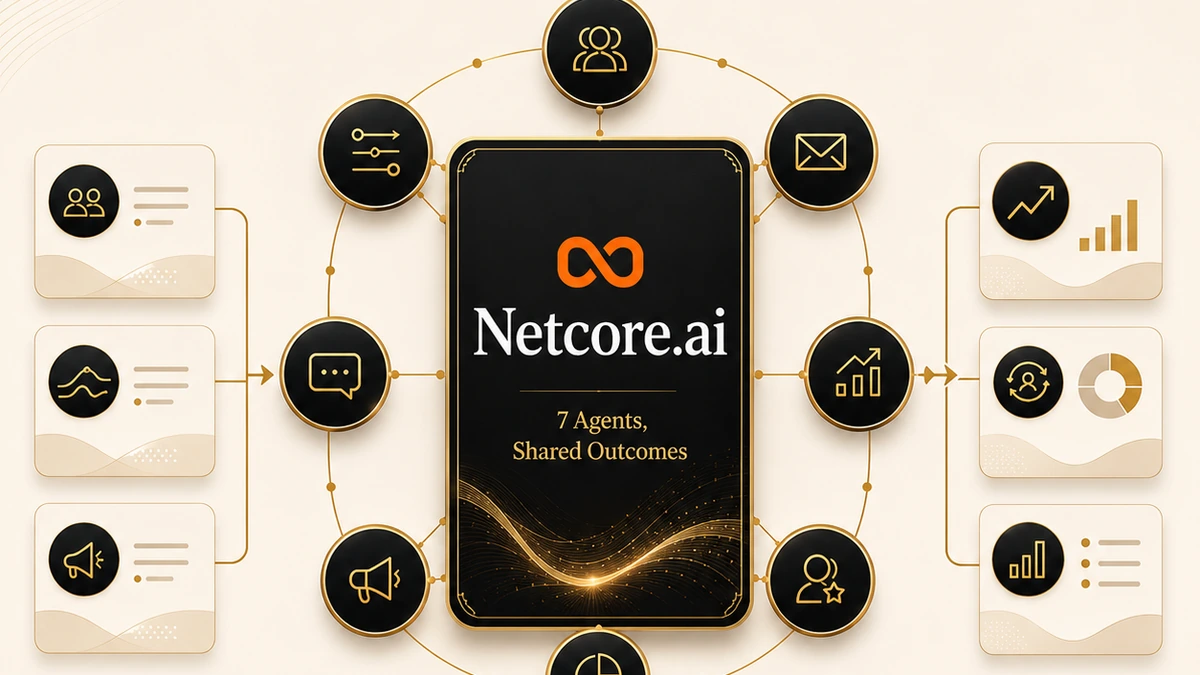
Netcore Cloud rebranded as Netcore.ai on July 30, 2026, positioning the company as an agentic marketing platform whose seven AI agents plan, execute, analyze, and optimize campaigns while Netcore growth engineers share responsibility for client outcomes.
The Netcore.ai agentic marketing model is attached to a wider operating system, not just a visual refresh. Netcore says customer engagement, product discovery, personalization, CDP, email, and CPaaS signals now feed a shared context and governance layer, giving every agent the same consent-managed customer view.
For martech buyers, the consequential claim is accountability. Netcore is asking to be evaluated against business KPIs rather than software adoption alone. That makes the contract, attribution model, and human escalation path more important than the number of agents on the product page.
Direct answer – what is Netcore.ai agentic marketing?
Netcore.ai agentic marketing is Netcore’s rebranded platform model, combining six specialist marketing agents with Co-Marketer to coordinate campaigns against business goals. Netcore says human growth engineers remain co-accountable and part of the platform fee is tied to customer KPIs. Buyers should verify the exact variable share and measurement rules because current Netcore pages show different percentages.
Key Takeaways
- Netcore announced the Netcore.ai rebrand on July 30, 2026.
- Seven AI agents are positioned to plan, execute, analyze, and optimize marketing across the customer lifecycle.
- A shared context and governance layer is meant to keep agent decisions aligned across channels and consent data.
- Each enterprise client is paired with a Netcore growth engineer who monitors performance and intervenes when judgment is required.
- Netcore’s public pricing pages currently describe both 30% and 25% outcome-linked shares, so buyers need the operative terms in writing.
What Netcore.ai Actually Changed
The rebrand brings Netcore’s customer engagement, product discovery, personalization, customer data, email, and communications products under one agentic-marketing position. The company says the platform is available now across India, Southeast Asia, the Middle East, North America, Europe, and Africa.
That broader scope matters because Netcore was already expanding beyond campaign messaging. Our earlier reporting on Netcore Unbxd’s AI product-search recognition covered the discovery and merchandising layer. Netcore.ai now frames product discovery, customer data, messaging, and lifecycle optimization as one coordinated system.
The architecture is built around a central context layer and a governance layer. In Netcore’s description, signals from each product feed a unified, consent-managed customer view, and decisions made by one agent become available to the others. A named growth engineer then supplies the human layer, monitoring results and stepping in where judgment or domain knowledge is needed. ADA’s retail decisioning expansion puts the same context-and-governance test into retail, where agents may influence prices, offers, products, and messages.
How the Seven Marketing Agents Map to Growth
Netcore’s May 2026 product release described six specialist agents coordinated through Co-Marketer. The important distinction is not that each agent has a name. It is that each one owns a different decision in the path from customer signal to commercial outcome.
- Insight Agent diagnoses why campaign or journey performance changed and recommends corrective action.
- Audience Agent builds and refreshes micro-segments using customer behavior and propensity signals.
- Scheduler Agent selects timing, channel, and communication pace to improve engagement without adding message fatigue.
- Content Agent creates channel-ready messaging based on campaign context and brand requirements.
- Decisioning Agent chooses the next best action for each customer in real time.
- Shopping Agent supports product discovery and conversational paths toward conversion.
- Co-Marketer coordinates the specialist agents, aligns execution with business goals, and applies governance across the workflow.
This is a concrete vendor implementation of the campaign-orchestration pattern in our agentic AI marketing use-case guide. It also changes how buyers should compare AI marketing platforms for B2B teams: the evaluation has to cover decision rights, shared context, and measurable outcomes, not only generation features.
Outcome-Linked Pricing Is the Real Test
Netcore’s announcement says engagements will be structured around client business KPIs, with Netcore teams financially and operationally invested in results. The release does not define the percentage of fees at risk, the KPI formula, the baseline, or what happens when a target is missed.
The company’s public pages add detail, but they are not yet consistent. Netcore’s main pricing page says 30% of the platform fee is tied to business KPIs. A separate customer-engagement FAQ describes a 75% fixed and 25% KPI-linked structure. The public explanation is not consistent enough to substitute for the contract, so buyers should get the applicable percentage and KPI terms in writing.
The category is already moving toward pay-for-results models. HubSpot’s Breeze outcome-based pricing charges for defined units such as resolved conversations and qualified leads. Netcore’s claim is broader because campaign outcomes, activation, retention, and revenue contribution can depend on product, price, seasonality, inventory, sales follow-up, and other factors outside the platform.
Our read: tying fees to growth is more meaningful than adding another AI assistant, but only when the measurement system is auditable. A variable fee without an agreed baseline, attribution window, exclusions, and remedy can still leave the customer carrying most of the risk.
What Martech Buyers Should Ask Before Signing
- Define the KPI and baseline. Specify the metric, historical comparison period, data source, and minimum sample size.
- Set the attribution window. Document which channels and touchpoints receive credit and how seasonality, promotions, inventory, and sales activity are handled.
- Confirm the fee at risk. Put the exact variable percentage, floor, cap, payment timing, and remedy for missed targets in the order form.
- Map agent authority. Separate permissions to analyze, recommend, create, approve, publish, and change live journeys.
- Name the human owners. Define what the Netcore growth engineer controls, what the customer team approves, and how disputes or model errors escalate.
- Protect rollback and portability. Require action logs, version history, export rights, and a tested route back to manual control.
The same discipline applies when AI agents enter revenue operations: a goal is not a governance model. Netcore.ai will be easier to evaluate when buyers can trace every agent action to approved data, a named owner, and a contractually defined outcome.
Frequently Asked Questions
Netcore.ai agentic marketing is the company’s model for coordinating AI agents across customer engagement, content, audience selection, timing, decisioning, and shopping. The agents use shared customer context, while a human growth engineer monitors performance and remains involved in the client’s growth goals.
Netcore has described Insight, Audience, Scheduler, Content, Decisioning, and Shopping agents, coordinated through Co-Marketer. Together they cover diagnosis, segmentation, timing, creative production, next-best-action decisions, product discovery, and cross-agent orchestration against business goals and governance rules inside a shared context layer.
Netcore’s main pricing page currently says 30% of the platform fee is tied to business KPIs. A separate customer-engagement page describes 25% as outcome-linked. Buyers should treat the applicable percentage, KPI formula, attribution window, and remedy as contract terms rather than relying on website copy.
No. Netcore’s announcement pairs autonomous execution with a human growth engineer who monitors performance, interprets signals, and intervenes where judgment matters. Customer teams still need to define goals, approve risk boundaries, supply reliable data, and agree on how business outcomes will be measured.