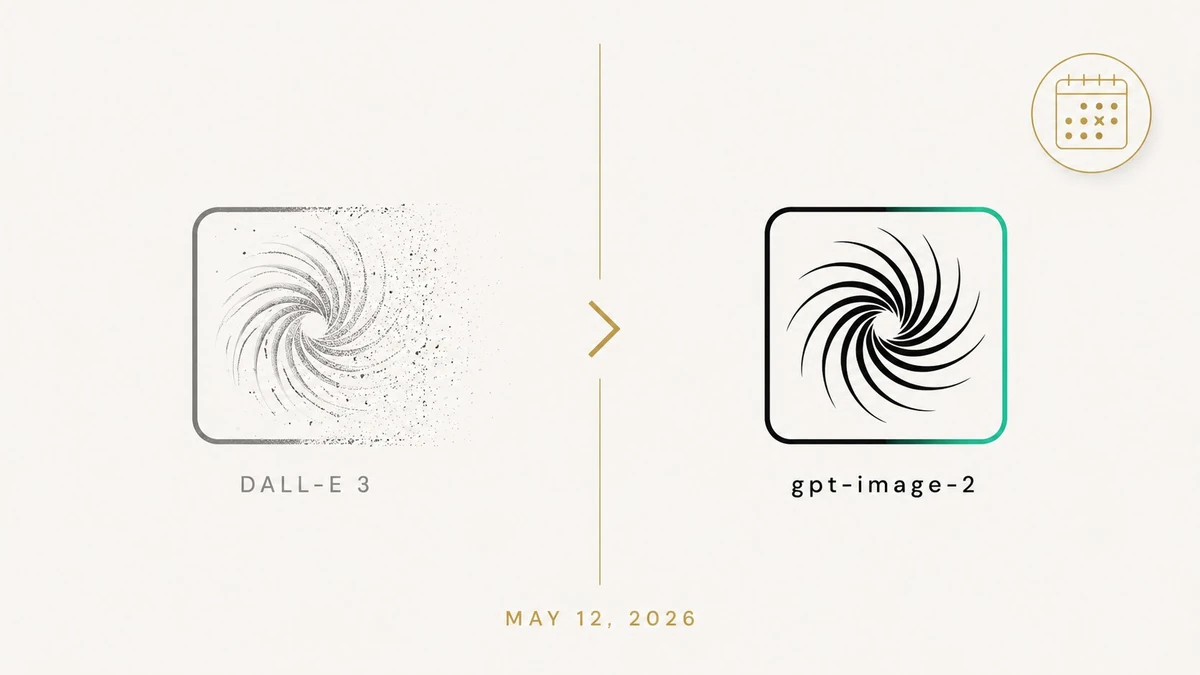
DALL-E 3 retires on May 12, 2026 on OpenAI’s API and consumer surfaces. Microsoft’s Azure OpenAI service set its own deprecation date of February 18, 2026, with a six-month extension for customers who requested one. Both deadlines fall inside Q2, leaving B2B marketing teams that built workflows on DALL-E 3 with a hard migration cliff and real confusion about what to migrate to.
The confusion is not accidental. Google’s AI Overview on the topic currently recommends gpt-image-1-mini as the designated successor to DALL-E 3. That recommendation is out of date. OpenAI shipped ChatGPT Images 2.0 (gpt-image-2) on April 21, 2026, with native reasoning, 2K resolution, and 8-image batch coherence. Gpt-image-2 is the actual successor for any team wanting the closest match to DALL-E 3’s strengths plus a meaningful capability upgrade.
Our read: B2B marketing teams have 14 days to either migrate to gpt-image-2, lock in Midjourney or Stable Diffusion XL as a fallback, or accept that their daily image workflow breaks on May 12. Teams treating this as a routine version upgrade will be fine. Teams that hard-coded DALL-E 3 into landing-page generators, ad-creative pipelines, or weekly social production without an abstraction layer will feel the deferred work catch up.
Key Takeaways
- DALL-E 2 and DALL-E 3 retire on May 12, 2026 on OpenAI surfaces. Microsoft Azure OpenAI deprecated DALL-E 3 on February 18, 2026 with a six-month extension still available.
- Gpt-image-2 (ChatGPT Images 2.0) launched April 21, 2026 and is the actual successor — not gpt-image-1-mini, despite Google’s AI Overview saying otherwise.
- Gpt-image-2 ships with native reasoning, 2K resolution (up from DALL-E 3’s effective 1024×1792), and 8-image batch coherence with character continuity.
- Teams using DALL-E 3 inside automated workflows (n8n, Zapier, Make, custom Python) need to update model identifiers and re-test prompts before May 12.
- For B2B-marketing fallbacks, Midjourney remains stronger for design-led creative; Stable Diffusion XL stays the best self-hosted option. Gpt-image-2 wins where text rendering matters.
The Two Dates That Matter (and Why They’re Different)
Two retirement dates are in circulation, and neither is wrong. May 12, 2026 is OpenAI’s hard cutoff for DALL-E 2 and DALL-E 3 across ChatGPT consumer surfaces and the API. After that date, calls to legacy DALL-E endpoints return errors. February 18, 2026 was Microsoft Azure OpenAI’s official model retirement date, with a six-month extension ending in late August 2026 for customers who opted in.
For B2B marketing teams, the practical date is May 12 unless your image generation runs through Azure with a confirmed extension. Most marketing automation runs through OpenAI’s API directly or through ChatGPT itself, hitting the May 12 cutoff. Azure-routed workflows have extra months but should not wait. The gpt-image-2 migration is the same work either way.
Gpt-Image-2 Is the Actual Successor — Not Gpt-Image-1-Mini
The Google AI Overview confusion is worth addressing because B2B teams using AI search to plan their migration are getting bad guidance. As of April 28, 2026, the AI Overview on the query “DALL-E 3 retirement b2b marketing” recommends gpt-image-1-mini and lists Midjourney and Stable Diffusion XL as alternatives. There is no mention of gpt-image-2. AI Overview citation rotation lags the news cycle by weeks.
The AI Overview’s training and citation data lag the April 21 launch. Gpt-image-2 is the model OpenAI itself positions as the DALL-E replacement across ChatGPT and the API, with the marketing budget and product roadmap. Gpt-image-1-mini is a smaller, cheaper sibling for high-volume low-stakes generation, not a feature-parity successor.
For B2B-marketing use cases, gpt-image-2 brings three improvements that matter. Text rendering is dramatically better — DALL-E 3 fails on logos and inline labels; gpt-image-2 produces working QR codes and dense layout text. Aspect ratios extend from 3:1 to 1:3, covering LinkedIn carousels, vertical Stories, and standard ad placements without external resizing. And character continuity across an 8-image batch lets one prompt generate a coordinated campaign set.
For teams building repeatable creative systems, image generation now sits inside broader agentic AI marketing workflows, not just one-off asset production.
What B2B Marketing Teams Should Migrate Before May 12
Three migration moves, in order of priority:
Audit every DALL-E 3 reference in your automation stack first. Search your n8n workflows, Make scenarios, Zapier zaps, and custom code for “dall-e-3” model identifiers. Most marketing teams have more references than they remember: landing-page generators, ad-variant batch creators, social-post illustration pipelines, newsletter image automations. Each needs the model identifier updated to gpt-image-2 (or gpt-image-1 if cost matters) and prompts re-tested. This is the highest-priority task for the next 7 days.
Re-test prompts; do not assume they transfer. DALL-E 3 had specific prompt patterns that worked: “in the style of,” explicit aspect ratio instructions, certain composition keywords. Gpt-image-2’s native reasoning means the same prompts produce different (often better, sometimes worse) results. Run your top 20 production prompts through gpt-image-2 and document the deltas. Prompts with rigid composition instructions usually need rewriting; gpt-image-2 reasons through composition itself and benefits from looser direction.
Lock in a fallback model for image-critical workflows. For any workflow where image quality affects pipeline metrics (paid ad creative, landing page hero images, gated-content covers), set up a parallel Midjourney or Stable Diffusion XL pipeline before May 12. Gpt-image-2 is new and will have rate-limit and reliability issues in its first 60 days. A documented fallback prevents a single OpenAI outage from breaking weekly creative. For teams already using n8n or Make for automation, adding a fallback branch is a one-hour task.
The broader pattern matches the AI subscription pricing reset happening across vendors this quarter: agentic AI tooling is changing faster than B2B marketing automation can absorb. Teams that built abstraction layers (one image function called from many workflows, swappable backend) will migrate in an afternoon. Teams that hard-coded “dall-e-3” into 40 different automations will spend a week. The May 12 deadline is a gift — it forces the abstraction work most teams have deferred.
Frequently Asked Questions
OpenAI is retiring DALL-E 2 and DALL-E 3 on May 12, 2026 across ChatGPT consumer surfaces and the OpenAI API. Microsoft Azure OpenAI deprecated DALL-E 3 on February 18, 2026 with a six-month extension ending in late August for customers who opted in. For most B2B marketing teams using OpenAI’s API directly, May 12 is the operative date.
Gpt-image-2 (ChatGPT Images 2.0, launched April 21, 2026) is the feature-parity-and-upgrade successor that replaces DALL-E 3 for most use cases. Gpt-image-1-mini is a smaller, cheaper model for high-volume low-stakes generation. Google’s AI Overview currently recommends gpt-image-1-mini, lagging the April 21 launch. Gpt-image-2 is the right choice for B2B marketing.
Some will, some will not. Gpt-image-2 uses native reasoning rather than DALL-E 3’s pattern-match generation, so prompts with rigid composition instructions often produce different results. Test your top 20 production prompts before migrating. Prompts describing the desired outcome conceptually transfer better than prompts prescribing exact composition.
For specific use cases, yes. Midjourney remains stronger for design-led creative where aesthetic quality is the primary criterion. Stable Diffusion XL is the best self-hosted option for teams with data-residency requirements or per-image cost concerns. Gpt-image-2 wins for editorial illustrations, chart-style graphics, and any case where text rendering matters. Most B2B teams will keep two options live.